Beauties of Blackpool: the Classic Attractions of Blackpool Pleasure Beach

There are few parks in the UK that sum up that seaside amusement park experience like Blackpool Pleasure Beach, and no wonder- in its 125 years of operation they’re sure to have picked up a few tricks. Since its opening in 1896, this beachside park has accumulated a lot of history, and has made its place in the UK themed entertainment industry as an attraction for thrillseekers and families alike.
Today, Blackpool Pleasure Beach is home to over one hundred attractions, from immersive dark rides like Valhalla to innovative and thrilling rollercoasters like Icon and The Big One… and with all this new technology its easy to forget about the early rides and attractions that made the Pleasure Beach what it is. This year is Blackpool Pleasure Beach’s 125th anniversary, so what better time to explore the stories of some of the park’s most classic and nostalgic rides, and celebrate all the history this park really has to offer!

River Caves, opened in 1905

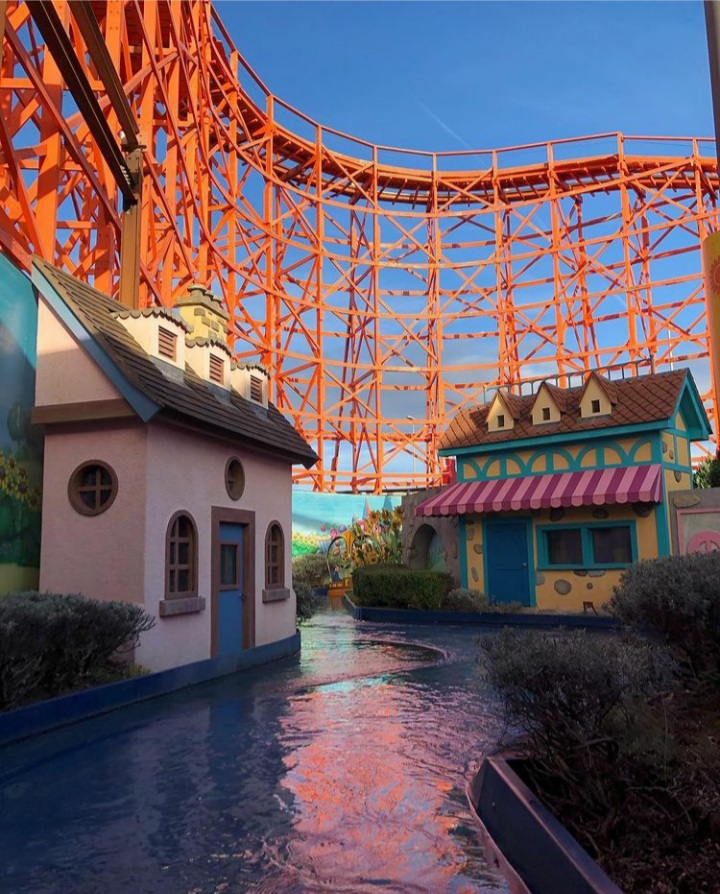
Where best to start off this list than with one of the oldest rides of all? The River Caves opened in 1905, just nine years after Blackpool Pleasure Beach opened, and brought to life the concept of dark rides before it was popular. This pioneering dark ride is the epitome of a gentle ride in the middle of what is essentially a thrill park: surrounded by all sorts of different coaster tracks and a stark contrast to a lot of the newer attractions around the Pleasure Beach.

Your experience begins as you enter under an arch stylised as a traditional ‘Tunnel of Love’, however this is where the romantic elements of this ride end. The surrounding screams begin to fade out as a voiceover welcomes you to “the River Caves at the fabulous Blackpool Pleasure Beach and you begin your expedition through time. There doesn’t seem to be much of a chronological order- which could be argued makes the ride even more fun and unpredictable, and the first evidence of this is when you go from a scene set in Ancient China, to one in the prehistoric era.

Jagged rockwork and the roars of dinosaurs fill the air as you gradually make your way to the next scene: a world under the sea. On this underwater adventure riders can spot fish swimming and jellyfish glowing, before rising above and into the jungle. A slightly unsettling crocodile watches you as you sail past, and when you see a spinning sun you know you’re safe from the croc’s hungry eyes. The next portion of the ride takes you underground, through a grotto of sparkling purple crystals.

The mine ends and a sign informs you that you are entering the Valley of the Kings, where the voiceover returns and tells the story of the Egyptian pyramids. Elaborate poles and statues line the walls of the scene, and as you enter the next room you are greeted by murals depicting Ancient Egyptian art. The final scene of the ride takes guests to the lost city of Angkor Wat, with animatronics and huge sets entertaining guests as they climb a lift hill.

If its a hot day and you’re looking for a way to cool off (Lets face it, the recent heatwaves in the UK have made us all want to!) the next and final part of the experience is perfect for you. With stunning views of BPB’s coasters Icon and the Big One, you descend down a small drop, getting a good helping of splashing in the process. If its cold or raining however, the splash may not be the most pleasant experience. Just make sure you’re wearing a poncho.

River Caves may have opened over a hundred years ago, when dark rides weren’t particularly common, but its age is almost imperceptible. Preservation and maintenance has meant that the ride has kept its fresh and charming feel throughout its operation, and this fun but underrated dark ride will likely continue to operate for years to come!

Nickelodeon Streak, opened in 1933

If you’re thinking ‘Nickelodeon wasn’t around in 1933!’, you’d be correct: it wasn’t actually founded until 1979. So how exactly did this 1930s wooden coaster come to be themed after a cartoon company? Well, it all started when the ride opened, not-so-creatively named Roller Coaster- between this name and calling another coaster The Big One, there has definitely been an improvement on BPB’s coaster names more recently.

This plainly-named Roller Coaster may have opened in 1933, but it has history dating all the way back twenty-four years before it debuted; before many of the rides on this list were even designed. Velvet Coaster, an out-and-back wooden coaster, opened in 1909, built by William H. Strickler who would also go on to build Big Dipper. Having been building and opening rollercoasters since the 1890s, BPB knew when it was time for a ride to be replaced, and when Velvet Coaster’s time came in 1932, plans began for a new attraction to take its place.
But with some parts of the ride still in full working order, Velvet Coaster would never truly be gone. The lift hill and a few other parts of the ride would form areas of the new rollercoaster, opening the following year. Interestingly, there’s also a block of holiday apartments and even a Wetherspoons not too far from the park, with the same name! On the Velvet Coaster Wetherspoons’ website it does state that the restaurant is named after the coaster, though I’m not sure if the same applies to the apartments.

The ride that replaced Velvet Coaster, named Roller Coaster, used the same out-and-back layout. Unlike its predecessor however, Roller Coaster has operated for a lot longer, at an impressive eighty-eight years as of 2021. The ride got rougher and older, but aside from that most things about it stayed the same- there was even an old train from Velvet Coaster displayed in the station. That was, until 2010, when Blackpool Pleasure Beach’s kiddie area Beaver Creek’s Children’s Park got a bright and modern refresh, and Roller Coaster along with it.

Nickelodeon Land opened on the 5th of May 2011, with many of the older attractions that were in the area before being completely rethemed. Roller Coaster’s neighbouring attraction, Zipper Dipper, became Blue Flyer, whilst the Roller Coaster itself was painted a bright Nickelodeon orange, renamed as Nickelodeon Streak. Nick Streak offers fleeting views of its surroundings, from houses to rollercoasters, and remains an icon (not to be confused with the coaster actually called Icon!) of Blackpool Pleasure Beach to this day.

Blue Flyer, opened in 1934

The opening of Nickelodeon Land was a pretty big event in Blackpool Pleasure Beach’s recent history, so its no wonder Roller Coaster/Nick Streak wasn’t the only coaster to get the Nickelodeon treatment. However, unlike its much more thrilling counterpart, this classic kiddie coaster is a lot tamer, and is painted blue rather than a bright orange. And these two neighbouring rollercoasters have actually been around nearly as long as each other.

Less than a year after engineer Charles Paige finished designing Roller Coaster, he began working on a new project, another rollercoaster with a slightly more creative name. With the help of Dayton Fun House and Riding Device Manufacturing Company, the new family coaster quickly came to fruition, and opened as Zipper Dipper in 1934. Little did designers and fans of the ride know back then, that this rollercoaster would grow to hold a lot of historical significance. According to historicengland.org, Blue Flyer is one of just six pre-WW2 coasters in the UK that are still operating, and is even the second oldest family coaster in the world!

Zipper Dipper continued to operate mostly unchanged up until 2010, other than a brief time when the ride was sponsored by food company Warburtons and became the Warburtons Milk Roll-o-Coaster. Even this didn’t really have much of an impact on the actual ride experience however- signage for the ride still called it Zipper Dipper, and a lot of guests probably did too. But the biggest change was yet to come.

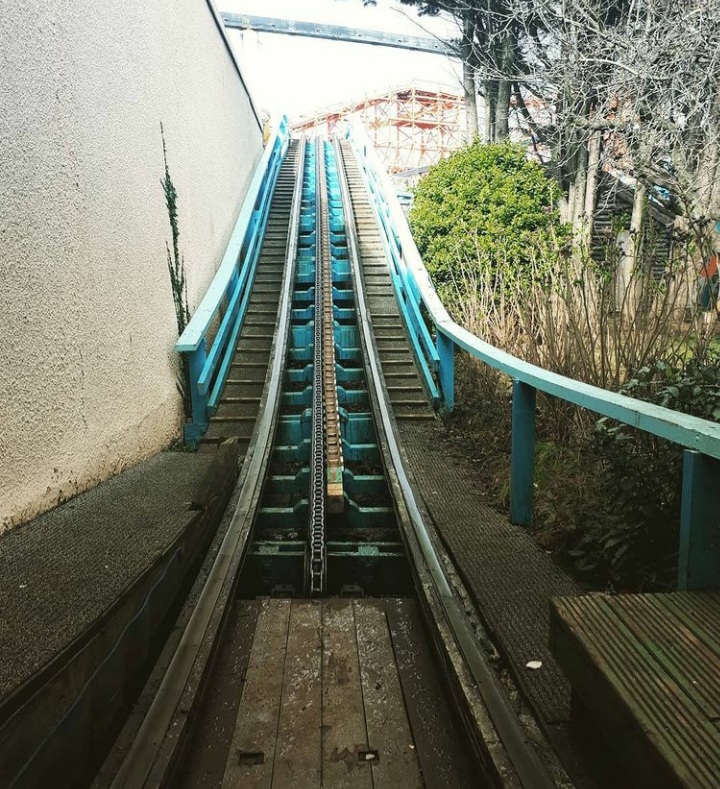
Beaver Creek’s Children’s Park was a theme park inside a theme park; too big to be a themed land but in a way it was its own park inside of Blackpool Pleasure Beach. This small park was home to an impressive ten attractions, from a teacup ride to a log flume, and of course Zipper Dipper. The whole area closed on 5th September 2010, and while some of its rides were removed, others were completely reimagined. Zipper Dipper’s transformation was one of the most drastic. The track and frame were painted a bright blue that contrasted well with Nickelodeon Streak’s orange, and the attraction was renamed Blue Flyer, loosely themed to the kids TV show Blue’s Clues.
Nickelodeon Land opened the following year on May 5th 2011, with a myriad of attractions from water rides, to rollercoasters, to even a Zamperla Disk-O! But while a 1930s family coaster themed to a show for young children may seem innocent enough, this isn’t entirely the case. Or at least, it was, until June 2016. Reported by the Guardian, four teenagers were described as having broke into Blackpool Pleasure Beach for a “4am Joyride” on Blue Flyer, before having a food fight and subsequently running away after being confronted by security. Come on, people, I know theme park tickets can be expensive, but THAT is quite extreme! In all seriousness, though, don’t do this. Park employees do not want to clean up your mess, and it is extremely dangerous to operate a ride without the proper training and safety checks.

On 4th April 2017, Blue Flyer’s historical significance was officially acknowledged with a Grade II listing, and it is also an ACE Coaster Classic. This little blue family coaster may not look like much, but there’s a ‘rollercoaster’ of a story within its tracks and trains!

Alice’s Wonderland, opened in 1962

No, I did not make a typo, and you did not read that wrong. While many of us loved as kids (and maybe still love!) a story and film named Alice In Wonderland, this classic dark ride puts a bit of a spin on the name, eliminating the ‘in’ altogether and adding an apostrophe ‘s’ instead. This dark ride adventure through Alice’s magical looking glass first opened in 1962, and at first glance seems remarkably similar to the original version at Disneyland. The two rides opened within five years of one another, they have the same highly-raised track on the outside, and were even built by the same manufacturer, Arrow Dynamics.

Check out this blog post to learn more about the history of Arrow Dynamics and its iconic attractions!

Arrow Masterpieces from Around The World

November 1945 was the beginning of something incredible for the amusement park industry, which then was practically non-existent, other than a few regional parks temporarily closed (that sounds all too familiar!) due to the Second World War. In a small workshop in Northern California, engineers Karl Bacon and Ed Morgan began a machine shop, and…

As you board your vehicle and tumble down the rabbit hole into the ride however, the striking similarities mostly fade out. Riders go on a bright and charming adventure through Wonderland, first being greeted by the very late White Rabbit, and soon travelling through a colourful flowerbed, a giant game of croquet and eventually ending with the playing cards being defeated as you leave via a track themed as a vine. And while the version at Disneyland uses voiceovers and sound effects for audio, this ride has a catchy soundtrack that sounds pretty similar to the “I’ve Got A Golden Ticket” tune from the film adaptation of Willy Wonka and the Chocolate Factory. Despite this, the soundtrack situation is probably just coincidence: Alice’s Wonderland opened with the music in 1962, nine years before the film was released.
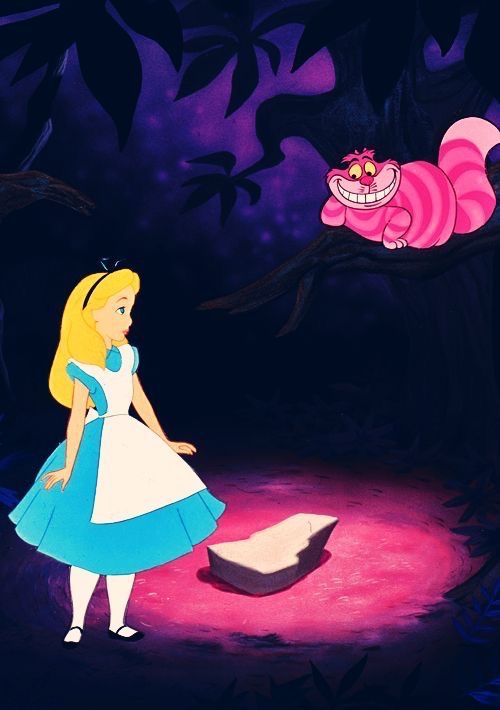
Alice’s Wonderland is one of the lesser known attractions at the Blackpool Pleasure Beach, and is one of the few dark rides in the UK that still holds the unique nostalgia and charm some parks have lost over the years. If you’re ever at the Pleasure Beach and have a bit of free time, this three minute experience is a great way to relax and take in the magic of the park!

Grand National, opened in 1935

The Grand National may be a famous horse race in the UK, but is also the name of one of the oldest rides at Blackpool Pleasure Beach! During the 1930s, the Pleasure Beach was going through a programme of expansion, described as the “greatest” in the park’s history, and even back then, expansions of major theme parks were bound to include a new or rethemed coaster. Work on the project began in 1933, and among various other attractions, were plans for a Mobeius Loop wooden rollercoaster, the fifth in the world.

The park’s owner at the time, Leonard Thompson, worked with engineers Charles Paige and Henry G. Traver, in order to make the dream a reality, and 3302ft of wooden coaster track later, it was. The ride, named Grand National, opened to the public in 1935. With trains that duel, a sign reading “they’re off” at the beginning of the ride and another reading “Winner’s Post” at the end, Grand National is designed to make you feel as if you are really in a high-intensity, high-speed horse race.

Despite getting off to a flying start, it has not always been plain sailing for this classic racing coaster. In May 2004, something went wrong with the lighting systems of Grand National’s station, leading to a fire destroying the station and damaging two other attractions. Both of these: the walkthrough attraction Trauma Towers and the dark ride Alice’s Wonderland, were able to reopen soon after the fire, and while Alice’s Wonderland is still operating, Trauma Towers closed a few years later. The station of Grand National was rebuilt, and the ride was eventually able to open in October 2004.

As with many famous older rollercoasters, this ride has had some… interesting events and gathered some pretty strange world records throughout its operation. On March 2nd 2019, 195 people had the unusual idea to break the world record for ‘Most Naked People on a Rollercoaster’ on Grand National, succeeding and still holding the record two years on. On a more heart-warming note, a marriage has also happened on the coaster! Andy Hine of the British Rollercoaster Club tied the knot while riding Grand National in the early 1990s, and one of the ride’s trains is now decorated with a plaque commemorating the romantic event.

Like Blue Flyer, Grand National has been recognised as a Grade II listed building, due to being one of just six UK rollercoasters opened before World War 2 to still be operating. Some riders can find Grand National to be pretty rough, but whether you enjoy this coaster’s sharp twists and turns, there’s no denying that it is a hugely significant part of Blackpool Pleasure Beach’s history, and will likely continue to offer thrills and headaches for many more generations of riders in the future!

Ghost Train, opened in 1930

Ghost Trains have been around for nearly as long as amusement parks themselves. The experience of sitting in a small ride car and passing by spooky scenes of varying realism has become synonymous with dark rides, and it seems almost every park has one. But where did these darkly-themed dark rides originate? Well, look no further than Blackpool Pleasure Beach! Blackpool’s Ghost Train gave its first ride in 1930, at the time being built on a single level and being pretty basic compared to the rides we are used to today. Back then, however, the attraction was revolutionary, putting a much darker spin on the ‘Tunnel of Love’ type rides that were so popular at the time.

The pioneer of the Ghost Train was now-defunct company Pretzel, who sadly did not make salty twisted bread treats, but instead built and designed rides for amusement parks and travelling fairs. Pretzel’s most successful model was The Pretzel (which the company was named after!), a type of dark ride that used a twisting track that creates a sense of immersion as you feel yourself going further and further into the attraction. Some say that the Pretzel got its name after a rider commented they “felt like I (they) were turned and twisted like a pretzel”!

Most Pretzel rides had a specific theme, and while some were relatively cheery, taking riders through a magical circus, winter wonderland or a lost mine, others were a bit more scary. One of these was the Devil’s Cave, which after a few rethemes was renamed Bucket O’ Blood, but thankfully the Pretzel ride built at Blackpool Pleasure Beach was slightly more family friendly. This version brought to life ghosts and ghouls instead of blood and devils, but it wasn’t too long before the ride would start to get a bit of a reputation for having real ghosts!

The Ghost Train is said to be haunted by the spirit of a former employee, named Cloggy, who during his life he was known for always wearing clogs when operating the ride. This hasn’t been the only supernatural event to plague the attraction however. Various ghosts and apparitions have been spotted, lights have supposedly turned on and off of their own accord, and the mischievous ghost of a nine-year-old girl has been seen in the gift shop moving items when no one is looking. The fear of ghosts on classic rides isn’t completely unique to Blackpool Pleasure Beach. Pirates of the Caribbean at Magic Kingdom has developed its own ghostly legends, surrounding a former employee named George who Cast Members must say ‘good morning’ to otherwise parts of the rides will malfunction and break down. Whether you believe in ghosts or think the whole idea is ridiculous, the thought that there could be spirits haunting these rides definitely adds an extra dose of fear when riding!

Since the Ghost Train opened in 1930, the attraction has gone through a few changes. Six years after the ride’s debut, it was redesigned by designer Joseph Emberton to have a second floor, and about twenty years later in 1957, when it was moved to make way for another ride, the Wild Mouse. The most recent major change made to the Ghost Train was in 1973, when the façade was updated to become an imposing, grey-brick castle. Today this old-but-fun dark ride continues to operate at Blackpool Pleasure Beach, and some say ghosts and ghouls can still be seen throughout the ride!

Big Dipper, opened in 1923

If there’s any ride that’s iconic to Blackpool Pleasure Beach, it’s the Big Dipper. Dating all the way back to 1923, Big Dipper features everything riders could ever want from a classic wooden rollercoaster, with drops, twists and turns blending together to create a thrilling and fun experience.

The story of the Big Dipper begins all the way over in Nebraska, five years before the ride would eventually open. Designer John Miller was enjoying a day at the amusement park Krug Park, when he had an idea. Before long, entire designs had been drawn up for an out-and-back coaster, inspired by Krug Park’s own ride of the same model and name. The Big Dipper at Krug Park actually had quite a serious accident in 1930 after a train derailed from the lift hill, but thankfully nothing of this severity has ever taken place on Blackpool’s version.

John Miller consulted with engineer William H. Strickler, and soon the project was well underway and nearing completion. The Big Dipper opened in 1923, with innovative side friction wheels to speed up the train, and a greater-than-90° bend. But little did anyone know that while the ride seemed complete, there would still be some pretty large alterations made to it along the way.

The first of these was in 1936, when Charles Paige was contracted to extend and improve the coaster. A few new drops were built, and arches were added over the South entrance to the park in order to increase the anticipation for guests wanting to try out the new-and-improved Big Dipper. The ride had to undergo repairs in 1975, after a fire destroyed the coaster’s lift hill and first drop.

Big Dipper continued to operate mostly without incident, until 2009, when a crash left twenty-one riders injured, some of which even had to go to hospital after being rescued. Work was undertaken to ensure something like this wouldn’t happen again. Seven months later, the Big Dipper reopened, with an updated track and some changes around the ride too, most notably a newly decorated station. The ride did end up derailing again in 2010, but there were thankfully no injuries and operations were able to resume later that day.

For many fans of Blackpool Pleasure Beach, Big Dipper is a nostalgic, fun ride that holds a special place in the hearts of many. In 1990, a teacher named Richard Rodriguez decided to take his love for the coaster to the next level, creating a new record by riding it for one thousand hours! Two years later he smashed his own record, doubling it to two thousand! That is some impressive dedication.

Big Dipper is the second oldest operating rollercoaster in the UK, just three years behind Scenic Railway at Dreamland in Margate. Whether it’s because of its age, the experience or just how iconic the ride is to Blackpool, there’s something special about a ride like Big Dipper, and with its hundredth anniversary coming up in a few years, I think its safe to say this coaster will continue to entertain for many more years to come!

Have you ridden any of the rides on this list? If not, what’s the oldest ride you’ve ridden? Let me know in the comments below!

If you enjoyed this article, be sure to check out our other posts from theme parks and attractions around the world, and find us on Facebook and Instagram for exclusive CoasterDreamers content!

Make sure you subscribe to have all the latest CoasterDreamers articles delivered straight to your inbox!

Photo credits:

@gingerfreckledgirl on Instagram Melissa 🎢 (@gingerfreckledgirl) • Instagram photos and videos

@diary_of_a_rollercoaster_girl on Instagram 𝓓𝓲𝓪𝓻𝔂 𝓸𝓯 𝓪 𝓡𝓸𝓵𝓵𝓮𝓻𝓒𝓸𝓪𝓼𝓽𝓮𝓻 𝓖𝓲𝓻𝓵 (@diary_of_a_rollercoaster_girl) • Instagram photos and videos

And be sure to check out their blogs here!

Ginger Freckled Girl – | Melissa | Theme Park Enthusiast | Travel | (wordpress.com)

Diary of a RollerCoaster Girl – Theme Parks & Roller Coasters (wordpress.com)

You are all clear… and outta here! Thanks for reading!

-Lily 🙂
Travels, Toys, Chocolate and Dungeons: The Magical History of the Alton Towers Dungeon

There’s only one theme park where you can be burned alive, hypnotised, and explore the meadow of In The Night Garden all in one day, and that’s Alton Towers. One of these things is not like the others, and that’s part of the reason we love this park so much- horror, thrills, calmness and magic combine to create an experience that truly has something for everyone.

In its forty years of operation, Alton Towers has been home to a range of attractions with all sorts of themes, and there’s no part of the park that represents this better than the show building of the Alton Towers Dungeon. While it may not seem like much, this building, nestled between Dark Forest and the World of David Walliams, actually holds a lot of history in its walls, and was once the location of attractions much more bright and colourful than the one that’s there now. Remember to keep your hands, arms and legs inside the boat at all times, as we explore the history of the Alton Towers Dungeon and everything that was there before!

A New Park with New Dreams

Throughout the 1970s and 80s, UK theme parks were booming. Despite never really having hardly anything big in terms of themed entertainment before, parks were popping up around the country. And while some people were concerned about the prospect of something that was until recently exclusively American, others were excited for the new era. Among these was property developer John Broome, who, after marrying the daughter of the estate’s majority shareholder Dennis Bagshaw, obtained the rights to the park and developed it into a full scale theme park.

Alton Towers theme park opened its doors on 4th April 1980, to a crowd of 30,000 guests eager to try out the new Northern attraction. Those visiting on opening day could twist and loop on Corkscrew, have a sliding adventure on a bobsled ride, and catch a show at the Cinema 2000, among several other experiences. But just like most theme parks in their opening year, Alton Towers wasn’t yet completed… in fact it was far from it.

Across the park, construction was continuing on a range of new rides and attractions from rollercoasters and log flumes to kiddie rides and haunted walkthroughs, and in a show building built to house two attractions at the bottom of the Talbot Street area, magic was happening. Attraction designer and developer Keith Sparks, in conjunction with Mack Rides, was working on a brand new dark ride for the 1981 season, based on a well-known story, which was sure to provide a unique and charming experience for the whole family to enjoy.

World-Travels and Water Rides

In 1873, writer Jules Verne introduced the world to Around The World in Eighty Days, a story following Phileas Fogg as he conquers the near impossible task of travelling the globe in quite a short space of time… eighty days to be exact! Alton Towers brought the adventures of Fogg to life a year after the park opened in 1981, when a new dark ride was opened with the same name. Unlike its neighbouring attraction Doom and Sons, which evoked fear in guests using illusions and special effects, the new dark ride created a very different feeling for riders: a sense of adventure.

Guests boarded their boat in the docks of London, and began their journey by setting sail across the River Thames. Before you knew it you would arrive in Thailand, on course to Egypt, where a mummy would welcome you to the Land of the Pharaohs, most likely creeping a few people out along the way. Next you would travel all the way from Africa to North America in the space of a few seconds, quickly arriving in New York City.

Standing at the foot of the Statue of Liberty, a man with a somewhat stereotypical American accent (though a lot of the accents on this ride were stereotypes!) would wish you a “real-good time” as you explored the city. After leaving New York and passing through the classic streets of Venice, guests found themselves in a slightly warmer and less secluded version of Antarctica, complete with igloos, sleds and an icy snowstorm.

In the next scene you would make a quick trip back to Las Vegas, where among flashing lights, Elvis Presley performed under glowing spotlights. Next you would return to Europe, exploring a ballroom in Vienna, then passing by the windmills of the Netherlands, before travelling all the way to Rio De Janiero just in time to experience the Rio Carnival. Your final stop would be Paris, where below hanging lights, artists painted, dancers performed in the Moulin Rouge and the Eiffel Tower stood tall (though not all tall as in real life obviously!) in all its romantic glory.

Up until 1990, the Paris scene acted as the ride’s finale, but after this, from 1991 until the attraction’s closure a few years later, your journey would take a seemingly random, and slightly spooky turn. Before reaching the station, guests would be greeted with a replica of a haunted house! This may seem like it had no business being on a family dark ride about travelling the world, but it was used to advertise Alton Towers’ new-for-1992 attraction, the Haunted House, which continues to operate today as Duel: The Haunted House Strikes Back.

Around the World in Eighty Days was a popular, beloved ride enjoyed by families and those who weren’t too fond of the Towers’ more thrilling attractions like Corkscrew or the Black Hole. But by the mid-90s however, things around the park were changing, and the ride gave its last tour around the world in 1993. Before long, plans began growing for a different, but just as enjoyable attraction to take its place.

A Magical Tour in the Land of Make Believe

Throughout the 1990s, some theme parks, particularly Disney parks, were home to A LOT of weird, obscure and sometimes even nonsensical attractions, but that didn’t stop Alton Towers from competing in the strange ride game too. And the thing about both Disney parks and Alton Towers is that they’re constantly changing and evolving, whether that be with new rides, theming or even new themed lands completely. This is what happened in 1993 in the Talbot Street area of the park.

Talbot Street had been home to A LOT of different attractions, from a carousel to a Schwarzkopf Jetstar III named Alton Beast, but despite its interesting past decade, it wasn’t too long before it was time for a retheme. With just six of the attractions it once had, Talbot Street became the Land of Make Believe in 1993, and a rethemed Around The World in Eighty Days planned to open the following year.

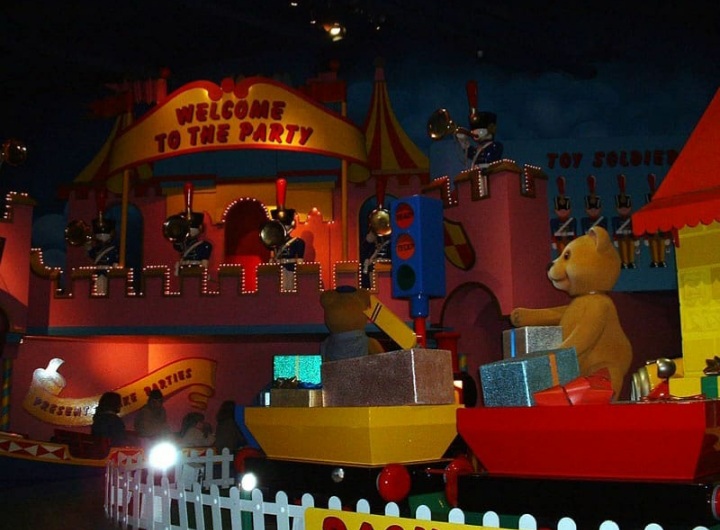
The new dark ride, named Toyland Tours took guests on a whimsical journey through a factory where larger-than-life toys catch trains, compete in races, throw parties and much more. Setting sail from a station themed as a paddle steamer named the S.S. Toyland Tours, you would soon find yourself in the colourful, very kinetic first scene of the ride.

Here, a pink elephant with flight goggles and a propeller on his tail would fly through the clouds, while down on earth, toy cars were having a pit stop and, rather strangely if you really think about it, bouncy castles were jumping up and down on a trampoline. Instead of going into all the complex Toy Story type logic of why some toys can come to life and why other can’t- this ride was opened before Toy Story was released, after all- lets explore the next scene, which was largely decorated with puzzles.

Rainbow puzzle pieces weren’t the only toy this room housed however- it was also themed as a teddy bear stuffing area! Two brightly painted robots oversaw the stuffing process, while four teddy bears could be seen sat on a red and yellow conveyor belt, not-so-reassuringly reading “danger.” The next scene took the idea of toys coming to life to a new, sugary sweet level, as guests could see giant dolly mixtures being created in a machine that looked straight out of Santa’s workshop.

After something so sugary it’s only natural that your hands might be a little sticky… which led fittingly into the next scene, all about the wonders of bathtime, and, of course, bath toys! Dolphins, rubber ducks, and bizarrely, the Loch Ness Monster, could all be spotted enjoying the bubbles as lights created the magical sense of being underwater.

Bubbles and bathtubs couldn’t compare to what was to come next though. As an icon of countless childhoods during the 90s, and even today, Sonic the Hedgehog made an appearance in his own video game scene filled with screens, deep blue lights and the nostalgic sound of someone doing amazingly well in a Sonic game and gaining a lot of gold coins. The popular speedy blue hedgehog actually has quite an interesting history with Alton Tower. There were times when Sonic could be seen as a walkaround character, as well as having themed hotel rooms and even a retheme of Spinball Whizzer to Sonic Spinball for the 2010 season!

After this it was party time, with characters such as a toy giraffe, teddy bear and even toy soldiers having organised a huge celebration complete with fairy lights, a castle and lots and lots of wrapped presents! There were even giant cakes, with a three tier wedding-style cake spinning and glowing, and several cupcakes swirling and turning on a turntable, like cups on a teacup ride. With an enhanced version of the soundtrack and an exit arch formed of oversized candy canes, the attraction came to a close and guests would leave through the station, likely accompanied by the catchy tune and excited memories in their head for the rest of the day.

Toyland Tours was a massive success at the park, and quickly became an icon of Alton Towers history, with its colourful visuals, movement-heavy scenes and whimsical storyline earning a place in many guests’ hearts for years to come. But as with many attractions, Toyland Tours soon came to the end of its life. Some scenes, particularly the video game scene featuring Sonic, were starting to become outdated, which wasn’t helped by the fact that the Sonic animatronic was beginning to fall into disrepair until it just hardly moved at all.

The park realised this and development began on something new, that would both keep the whimsical feeling of the area that was now Cloud Cuckoo Land alive, and update the attraction for a modern audience. Early on in the 2005 season, it was announced that Toyland Tours would give its final tour that year, and a ride based on everyone’s favourite magical chocolate factory would replace it in April 2006.

From One Factory to Another

Whether you grew up with the 1971 or 2005 version, it’s likely all us at some point dreamed of finding a golden ticket and going on a magical tour through Willy Wonka’s eccentric and probably quite dangerous chocolate factory. By 2006, a year after the newer version of the film was released, Alton Towers decided it was time to bring this musical fever dream of a factory to life, in the form of a new dark ride that would take the place of Toyland Tours.

But while Toyland Tours was just one attraction, Charlie and the Chocolate Factory: the Ride would included three! Guests would experience the dark ride as usual, passing through scenes from the ride stylised to the illustrations of Quentin Blake, then, in an unexpected turn, have the opportunity to rise, drop and explore the factory one of two iconic Great Glass Elevators! Sadly however, you wouldn’t actually travel in a gravity-defying lift: this part was created by two simulators.

Like many dark rides, the experience began before you even entered the show building, with an elaborate and immersive façade to really set the scene. This one was painted purple, beige and yellow, with bright blue windows showing children dancing, alongside grey pipes that stuck out into the sky to create the illusion of a factory. On entering the building, guests were greeted with the sweet scent of chocolate, as well as a preshow scene in which Willy Wonka and Charlie welcome you to the tour. After walking past illustrated portraits of the kids who didn’t have a great time at the factory in the book and movies, you soon board your boat, and set sail for your first stop: the Chocolate Room.

Here pipes and chocolate plants lined the walls (though the ones on the ride weren’t edible!) and, just like in the book and films the ride was based off, Augustus Gloop was being sucked up the pipe, his mother looking on shocked. In a voiceover from Willy Wonka and the remaining four kids, it is explained that he is going to the fudge room, as you head into the next scene. This next room, named the Inventing Room, was filled with whimsical machines, along with Violet Beauregarde being inflated to the size of a giant blueberry. We are told she is headed to the juicing room, and move onto the next part of the ride.

After a tunnel scene with mostly just music and blue lights, we arrive at the Nut Room, with Veruca Salt declaring that she wants a squirrel. Screens show her getting attacked by the squirrels she tried to take, and we learn that she has been declared a bad nut and sent down the rubbish chute. This scene was quite different from the one in the original book and movie- in the originals, Veruca tries to steal a golden egg from a magical chicken instead!

The boat ride ends here, but there’s still lots of magic left to experience. After disembarking, guests head to the TV Room, advertising treats such as Forever Freeze Ice Cream and Television Chocolate, and soon it starts to feel as if you are really inside of the screen. After a while the adverts flick off to show Mike Teevee being shrunk, and you get to go the part of the ride that everyone has been waiting for: the Great Glass Elevator.

From a vantage point in a simulated sky, guests could complete without even going anywhere: simulator technology and 3D effects create the feeling that you are moving and juddering through the factory at high speeds. Once your elevator has smashed through the factory roof, you plummet to the ground, ready to explore the rest of Cloud Cuckoo Land and Alton Towers.

Although it wasn’t as elaborate or long as either Around the World in Eighty Days or Toyland Tours, Charlie and The Chocolate Factory was an enjoyable ride in its own right, combining two mini pre-shows, a dark ride and a simulator to offer an experience unlike that many other attractions. The ride was often greeted with lengthy queues up to ninety minutes, likely due to the amount of parts to the experience.

However, just like the boats on this attractions didn’t travel as far, Charlie and the Chocolate Factory’s time of operation didn’t last as long compared to its predecessors- but not because of a lack of popularity. After the tragic Smiler crash in June 2015, several attractions around the park remained closed for the remainder of the season. These included Hex, Ripsaw, the Flume and Charlie and the Chocolate Factory, and while some, like Hex, did reopen the following year, the latter attraction did not. The ride was boarded up, and the building that once held rides that had entertained generations of guests stood standing but not operating.

A Dungeon of Legends and History

Years passed and when 2018 came around, plans were appearing for a new development to take the place of the closed ride. Rumours began circulating on what was being planned, and when Alton Towers filed a trademark application for the name “Alton Towers Dungeon” in Summer 2018, it became clear that this new attraction wasn’t exactly going to be a magical family adventure like the ones that had been there previously.

Work began on removing the theming of the Chocolate Factory, with some of the more iconic parts being auctioned off to raise money for charity. It wasn’t too long before an announcement came from the park, confirming on 11th October (two weeks before Halloween, I like to think that was intentional!) that the Alton Towers Dungeon would give its first spooky tour in Summer 2019.

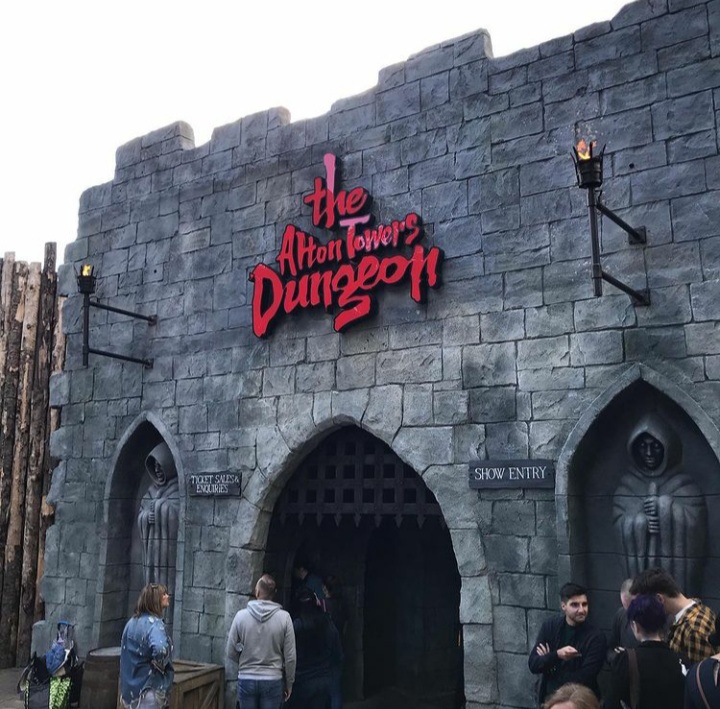
The Dungeon opened as an upcharge attraction a few months earlier than announced, on the 23rd of March 2019. Most of the experience was pretty similar to the iconic Dungeon attractions in London, Edinburgh and other UK cities and tourist spots, with segments such as a Plague scene and a not-so-relaxing boat ride all finding a home in this version, but with a twist. Similar to Hex, the Alton Towers Dungeon takes inspiration from Staffordshire’s history for parts of its storyline- most notably the Molly Leigh part of the walkthrough, which is based on a local legend.

The Dungeons promise to offer a tour of the “darkest past”, and it certainly delivers on that front, allowing brave guests to experience the plague, meet the ghost of a witch, and take a traitor’s expedition down the Black River. Today you can still come face to face with all these horrors and more at the Alton Towers Dungeon… that is, if you’re willing to endure pain at the hands of the Torturer and maybe even get hands on with the help of the plague doctor!

The Future of the Dungeon

The Alton Towers Dungeon may be a trip through some not-so-magical parts of the past, but lets break free from the rusty shackles of the dungeon for a bit and take a look at the future. Often walkthrough attractions like this are only temporary, and, most of the time, don’t last longer than the park’s Halloween event, but the Alton Towers Dungeon has already outlived many walkthroughs like it. Take into account that the Dungeons are a pretty well established brand in the UK, and that Alton Towers has only just opened a new dark ride in the form of Gangsta Granny the Ride, and it’s looking like the Alton Towers Dungeon is here to stay! Though if it is going to remain a permanent attraction, hopefully the upcharge will be lifted soon.

Despite this, the Alton Towers Dungeon needs A LOT of actors to operate the scenes and keep the fear factor high, which must be massively expensive for the park, which is probably why the attraction still operates on an upcharge. Each of the other Dungeons have the same thing, however the ones in London, York, Blackpool and Edinburgh are all just one attraction with nothing else that needs to be operated or paid for, and while Warwick Castle, the other Dungeon location, does have other attractions, there aren’t nearly as many as some major theme parks. Alton Towers is home to over forty other rides and attractions, all of which need frequent maintenance and safety checks to ensure everything is operating correctly. This means that at some point, the park may decide to divert more money and employees towards their more popular rides if they start to struggle financially, and be forced to close their version of the Dungeons.

Until now however, the Alton Towers Dungeons have proved to be relatively popular and a good fit for the park, especially for if it’s raining and/or you’re looking for an extra thrill on top of the rollercoasters and flat rides. Hopefully this terrifying walkthrough continues to operate for years to come, and when it does eventually get replaced, its replacement will have the same (or higher!) level of popularity and magic of the attractions that were there before!

Have you had the chance to experience any of these attractions? If not, which would you most like to have experienced? Let me know in the comments below!

If you enjoyed this article, check out some of my other posts from theme parks around the world, and find us on Instagram and Facebook for exclusive CoasterDreamers content!

No Way Out: The History of Thorpe Park’s X and the Walking Dead

Throughout its forty-three year history, Thorpe Park has been home to some pretty amazing rides. From petting farms to high-speed thrill rides, there has always been something for everyone, and some attractions leave more of a legacy than others. Among now defunct greats is X:/ No Way Out, which took riders on an adventure through…

Reaching for the Skies- the Evolution of London’s Airports

CW: Mentions of War and the Pandemic For years, aviation has been a massive part of the travel industry, whether you’re travelling to a far-flung location, or your destination is just a little too far to drive or go by ferry. But like any flight, the story of London’s five airports hasn’t been without turbulence.…

From Europe and Beyond- the history of Center Parcs | DreamVenture

If you’ve booked a European holiday in the past fifty-four years, chances are you’ve at least come across Center Parcs. First founded in 1968, this popular holiday park chain provides holidays aimed at those looking for an adventure, but also to escape the stresses of day-to-day life. But with an impressive twenty-eight resorts, two brand…

Subscribe to have all the latest CoasterDreamers articles delivered straight to your inbox!

Photo credits:

@attractionsource on Instagram Attraction Source (@attractionsource) • Instagram photos and videos. Community website: attractionsource – AttractionSource | bio.fm

@the_park_life_official on Instagram The Park Life (@the_park_life_official) • Instagram photos and videos

You are all clear… and outta here! Thanks for reading!

-Lily 🙂
Celebrating the Strange: The Weirdest Disney Theme Park Parades

If there’s one thing you can expect to find in many Disney theme parks, it’s parades. Since the first ever Disney daytime parade, the Character Parade, made its debut in 1971, these massive-scale street parties have been almost as iconic to Disney as castles and rides, and add an extra layer of musical magic to these already magical theme parks. Up until recently you could catch a parade at the Disneyland-style parks in California, Florida, Paris, Tokyo, Hong Kong and Shanghai, and in the slightly more distant past, at parks like Epcot and Hollywood Studios.

But while some shows and parades are whimsical, enchanting and full of excitement, there are some that manage to entertain in strange ways no one thought possible. From a show that allowed you to meet Barbie in World Showcase, to one that misinformed guests about world history with the help of Goofy, take your seat or find a spot on Main Street and join me as I explore the weirdest and most eccentric Disney theme park parades!

If you just can’t get enough Disney Parks strangeness, check out these posts on the weirdest Disney attractions, past and present!

Character Parade, Magic Kingdom (October-December 1971)

Where best to start this list than with the parade that started it all? Compared to the elaborate parades we have today, Magic Kingdom’s Character Parade may seem a little bland, with just a few antique cars, a marching band and a relatively limited set of characters, but the concept of a parade in a theme park was a completely new one back when the park opened its doors in 1971.

There isn’t a huge amount to talk about with this short but sweet original Disney parade, and it only lasted for a few months before Disney realised that there was real potential for a parade. Soon work began to go bigger and better with the next one, this time featuring floats, more characters and, later on in the parade’s lifespan, a large, quite intimidating dragon. This one didn’t breathe (or catch!) fire however like the Disney parade dragons today!

Cavalcade of Characters gave its first performance three years later in 1974, and along with its predecessor the Character Parade, paved the way for the iconic Disney parades we all know and love today!

Aladdin’s Royal Caravan, Hollywood Studios, Disneyland and Disneyland Paris (December 1992-August 1995)

In a parade themed around a film set in the distant past (or thousands of years in the future if you believe that theory!) it would be a bit weird to see a caravan like the name of this 90s parade suggests. But although an Aladdin-themed caravan would be pretty cool, Aladdin’s Royal Caravan didn’t exactly include any motorhomes, just the genie on every single float in the parade.

Aladdin was released in cinemas on 25th November 1992, based on the classic tale of Arabian Nights, and follows the adventures of ‘street rat’ Aladdin, wonderlust Princess Jasmine, a sentient flying carpet and their friends as they work to defeat the Sultan’s advisor Jafar as he attempts to take over the kingdom, and as you can imagine from the fact they made a parade, it was extremely popular. Parades themed to just one film or character aren’t as common now as they were back then, but they still exist, however they are a lot less weird today than they were at the height of their popularity.

This genie-fest of a parade started off strong- and gigantic- with the first float being a thirty-two foot genie looking very smug with his arms crossed and a big grin on his face. Performers would dance and hold up banners just in front to the song Prince Ali, making guests feel as if they were really in Agrabah when Aladdin and Genie were giving their Prince Ali parade.

The next float would introduce you to the “seventy-five golden camels” Aladdin is said to have in the song (‘don’t they look lovely, June?’), though a little disappointingly only two could be seen. After this the Genie seems to be having a little trouble with his body- with his top half being flown on a balloon, and his bottom half walking along the parade route of its own accord. Ah, Disney, the happiest place you can see some of your favourite characters- from Heimlich of A Bug’s Life to Genie from Aladdin- chopped up into a concerning amount of pieces. Soon another one of Aladdin’s seventy five camels strides onto the parade route (though not golden sadly!), carrying Genie sitting for some reason in a bathtub, his body intact this time.

Following behind a range of performers in a range of costumes, came a float containing a regal golden palace…but it wouldn’t be a float in this strange parade without the Genie, and he appears twice this time, once in a snake basket and then spinning around on a pole. From this point there was another string of performers, and of course another Genie, before we actually get a glimpse of both the title character of both the parade and the movie. Here Aladdin can be spotted standing on top of his monkey-turned-elephant Abu, waving down to guests and probably wondering why on earth the Genie had to steal his show. The last thing guests would see before the parade ended was Jafar, pushing around some kind of golden contraption that, judging by the annoyed shouts from inside, contained his bird sidekick Iago. I kinda feel bad for Iago, he’s always getting pushed to the side and having his ideas stolen by Jafar!

Aladdin’s Royal Caravan, although not featuring a caravan or seventy-three of the golden camels mentioned in the song, ran for three years until August 27th 1995, to be replaced by the Toy Story Parade at Hollywood Studios in Florida, and the Lion King Celebration over at Disneyland in California. The Disneyland Paris version only ran for a short while in 1993. While the premise of the parade wasn’t particularly strange, the way it was executed certainly was, and some of this Aladdin craziness can still be found at Walt Disney World today. If you go to the Magic Carpets of Aladdin ride in Adventureland at Magic Kingdom, you can still spot two of the camels that were used in the parade! It really is amazing how Disney places relics and Easter Eggs to the attractions and shows of the past around the parks, to remind of the magic that once was and still is.

Mickey Mania, Magic Kingdom (June 1994- September 1996) and Tokyo Disneyland (1995)

If there’s any attraction, show or parade at the Disney parks that will convince you that Mickey is more than a little full of himself, it’s this one. The Mickey Mania Parade ran during the mid-1990s in Magic Kingdom and Tokyo Disneyland, and was a Mickey Mouse superfan’s dream, bombarding you with more of the mouse than you ever expected to see in the space of twelve minutes. Other characters made an appearance too, including Peter Pan, Alice, and Goofy, but, as the soundtrack says, Mickey Mania was essentially just “miles and miles of mouse”.

The versions in Florida and Tokyo were largely the same, and both began with a float stylised as a playground with a spiral slide and a bike ramp, featuring Donald, Pluto, Roger Rabbit and bizarrely not Mickey. But never fear, because it wasn’t too long before Mickey would show up, in the form of an inflatable Mickey inside a wire Mickey head shape on wheels. That’s a lot of Mickey… and at this point we’re only about three or four minutes in! The Mickey-fever continued with six inflatable walking Mickey oval shapes (definitely one of the weirdest looking parts of this parade!), followed by a short break from the mouse, brought to you by performers on space hoppers.

The next float was dominated by what is likely the largest Mickey head any of us have ever seen, displayed by a giant balloon and accompanied by Goofy and his son Max, as well as a few more balloons with Mickey’s face on them. After another wire-Mickey-silhouette-on-wheels, the parade would take a bit of a turn for the random, as if it wasn’t strange enough already. Characters including but not limited to Peter Pan, Wendy Darling, Pinnochio, Alice and the Mad Hatter rode by on bikes, before Winnie The Pooh could be spotted waving from another Mickey-centric float. This float was a little more magical and whimsical than the others, decorated with bright spinning turbines and more Mickey teddies than you can possibly imagine.

A few random characters later, a music-themed float would appear, featuring Minnie and of course some more Mickey. The next segment was themed to the magic of time and clocks, featuring some walking analogue clocks just casually strolling along as if they aren’t in the middle of one of the weirdest parades ever to decorate the streets of Magic Kingdom and Tokyo Disneyland.

Soon it was about time (I’m sorry!) for another float, this time full of colourful cogs, Chip and Dale, and a Mickey Mouse with arms that move 360° around in a clock-like manner. After this more characters could be seen, with Jiminy Cricket, Cogsworth, The White Rabbit from Alice in Wonderland, and the Tick-Tock Croc from Peter Pan, before the parade launched into its weirdest and creepiest segment yet. Mickey’s feet and hands would dance along the parade route, while the mouse himself stands on top of a float, probably in disguised horror as his detached body parts move along without him. And on this slightly concerning note, the parade ends, leaving guests to think about what on earth they just watched.

Mickey Mania continued to entertain and confuse guests throughout 1995 in Tokyo, and all the way until Autumn 1996 in Florida, before the mouse-insanity (mousesanity?) gave its final run and was replaced with other parades in the months following. Today, the parade is renowned as one of the strangest parades ever to be performed at a Disney theme park, and although there are some amazing parades at the parks currently, it is unlikely any can ever accomplish the strangeness of Mickey Mania or some of the other parades or shows on this list!

Magical World of Barbie and the LiMOUSEine, Epcot (1993-95)

Of all characters you would expect to find at a park themed to innovation and world travel like Epcot, Barbie is probably near the bottom of your list, especially considering that she’s not actually a Disney character. But just as in Barbie’s world “anything is possible”, any kind of randomness was possible in the early decades of Epcot, and this included the chance to meet Barbie and all her friends in the American Adventure pavilion in World Showcase.

The Barbie takeover began when toy company Mattel began sponsoring It’s A Small World over at the Magic Kingdom, and before long, Barbie was made Disney World’s “Ambassador of Friendship” in 1994. Disney and Mattel did try to market this as being because Barbie has represented so many cultures and nations around the world, but it was much more likely because of the sponsorship. By the end of 1993, a new show had debuted at World Showcase’s American Adventure, encouraging guests to use their imaginations and believe anything is possible, with the help of the characters you have heard of, like Barbie, Ken and Skipper, and the ones you probably haven’t, like Todd, Stacie, Jackie and Midge.

The show, titled Magical World of Barbie, ran until May 1995, and although it stole most of the spotlight, guests had another chance to see Barbie and all her friends, in what was sort of a parade, sort of a character meet-and-greet. In a stunning yet surprising contrast to the sophisticated architecture and theming of World Showcase, Barbie could be spotted near a bright pink life-size toy limo! Creatively named the LiMOUSEine, the car was originally created as part of Mickey’s 60th Birthday celebration in 1989, but was painted pink and quickly became the epitome of Epcot using IPs before it was popular. Hey, at least the ones now are actually owned by Disney!

The Magical World of Barbie celebration lasted until mid-1995, when the LiMOUSEine left Epcot and Barbie went back to just being a toy, and more recently, a movie character. Barbie wasn’t the only non-Disney children’s character to have a show at Disney World at the time however: the Teenage Mutant Ninja Turtles could also be found at Disney-MGM Studios! Of all the attractions and shows Walt Disney World has been home to since its opening in 1971, the early 1990s really did have some of the strangest of all.

The World According to Goofy, Disneyland (June-November 1992)

Have you ever wondered how some of the biggest global eras and events would have played out if Goofy had been there? No? Well, even so, you could previously find out at Disneyland in California, with help from a parade titled The World According To Goofy, running from June to November 1992. The parade was created to celebrate Goofy’s 60th birthday, and was designed to feature all things Goofy, which may not sound particularly strange, but during the “Disney Decade” of the 1990s, Disney found ways to make everything a little bit weird and/or random. What made this parade weird however, was that it was essentially a giant misinformation session on world history, and showed guests what various eras would have been like if Goofy had existed during those eras.

The World According To Goofy made its debut on the streets of Disneyland on the 19th June 1992, and began with Professor Ludwig Von Drake from Ducktales greeting guests from a parade float stylised as a pile of history books. Surrounded by students dancing and holding their school books, Professor Von Drake would introduce guests to the theme and theme song of the parade, and prepare you for your history lesson through time.

Soon guests would travel back to the prehistoric times, or, as the parade called it, the “Pre-Hysterical Age”. Here they would encounter a range of cave-people and colourful dinosaurs dancing behind a parade float decorated as a book, but the strangest part of this segment was the giant blue brontosaurus with Goofy’s face on it! Goofy is supposed to be a dog so whether this was intended to be some kind of dog-dino hybrid I’m not sure, but its sure not what you expect to see at Disneyland! Animal Kingdom would be more likely, but as that didn’t exist back when this parade did I guess Disneyland was where you could get your Disney dinosaur fix.

The next part of the parade would take you into the “Egyptian Daze”, which for some bizarre reason was displayed as a giant game of golf. The pharaoh King Putt would appear alongside Clarabel Cow as Cleopatra (there really were some lesser-known Disney characters in this parade!) and of course lots and lots of Goofy, with Goofy as the Sphinx and Goofy as a mummy. For an even more bizarre unknown reason, Goofy could also be seen as a walking golf ball, complete with his signature green hat. I suppose this could be considered the slightly smaller and less iconic equivalent of the Epcot ‘Golf Ball’!

After this strange game of golf had ended, guests would be introduced the “Renais-Sauce”, which unfortunately was not a delicious new type of pasta sauce, but the parade’s representation of the Renaissance era, complete with all the fried chicken and pizza you could ever ask for. Performers would scoot around carrying stacks of what Disney Wiki calls “pizza pies”, and the majestic “Leaning Tower of Pizza” would bring up the rear of this segment of the parade.

The next and final segment, named Goofy Runs for President, as you can imagine shows Goofy blazing the trail for the recent trend in celebrities running for president, demonstrated by a marathon with Goofy his friends, and a few performers. Donald, Pluto, Chip and Dale could be spotted riding Goofy’s Pace Bus, while Mickey and Minnie would ride another float stylised as a finish line, accompanied by, you guessed it, another Goofy, giant this time! Even if Goofy has got some unusual election techniques, he’s got my vote!

The World According to Goofy may have been one of the strangest parades to ever grace the streets of Disneyland (and trust me, that’s saying something!), but it did in fact do what it was supposed to quite well. Attractions like Spaceship Earth over at Epcot (which is actually pretty similar if you think about it!) also aim to teach guests about the evolution of the world and world history, yet this parade achieved this in a bright, colourful format which was easy for younger and older guests alike to comprehend and enjoy.

The World According To Goofy gave its final show on the 15th of November 1992, and although there have been many more parades at Disneyland since then, this one is still remembered for its catchy soundtrack, unique plotline and eccentric scenes, and most likely will be for years to come!

What’s your favourite theme park parade, at Disney, Universal or any other park? Let me know in the comments!

If you enjoyed this article, be sure to check out my other posts from theme parks around the world, and find us on Instagram and Facebook for exclusive CoasterDreamers content!

Race into Obscurity- the high-speed history of Disneyland’s Rocket Rods

Of all the themed lands that have ever entertained guests at Disney parks, Tomorrowland has always been one of the most problematic. This hopeful world has gone through a range of updates since it first debuted with Disneyland in 1955, mainly to make sure it always remains as a promise of what’s to come, rather…

Theme Park Things to Look Forward to in 2022

To say this decade so far has been crazy would be an understatement. From pandemics to who knows what else, its certainly been a rollercoaster… and not a fun one either. But that’s not to say there haven’t been some positives. In the last year alone we’ve heard much-anticipated announcements and seen new rides that…

Drops, Tracks and Sheds: the twisting tale of Mystic Timbers

Every theme park has that one thing they’re amazing at. At the Disney and Universal parks it’s immersive dark rides, at the Legoland parks it’s creating attractions that really look like they have been made from giant building blocks… and at Kings Island, the specialty is wooden coasters. Since the success of the Beast in…

Subscribe to have all the latest CoasterDreamers articles delivered straight to your email inbox, so you’ll never miss an upload!

Photo credits:

@wishesonmain on Instagram Julian (@wishesonmain) • Instagram photos and videos

You are all clear… and outta here! Thanks for reading!

-Lily 🙂
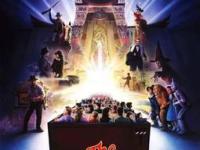
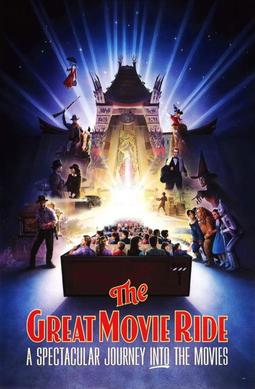
No Ordinary Tour: the History of Hollywood Studios’ Great Movie Ride

Movies are amazing, there’s no doubt about that. In less than three or four hours you can travel the world, go backwards or forwards in time, or explore a completely different world altogether, meeting some incredible characters along the way. But what if you could really step inside some of your favourite films? Well, once in the history of Walt Disney World Florida that was possible, on The Great Movie Ride.

Formerly located at Disney’s Hollywood Studios, this unique opening day dark ride took guests on a tour through the history of cinema, allowing you to come up close and personal with your favourite movie characters using a mix of actors and animatronics, and earning its place in the hearts of many guests over its twenty-eight year operation. My name is Lily, and I’ll be your tour guide today as we explore the magical history of the Great Movie Ride, so keep your hands arms and legs inside the vehicle at all times… because it’s showtime! Action!

The EPCOT Concept

The nine Future World pavilions of EPCOT Center were icons of the Disney parks, and bringing to life the magic and science of imagination, communication, transport, health, innovation, the ocean, the land, and of course predictions for the 21st Century. But in some of the first concepts for theme park EPCOT (after the city idea was shelved!) there was meant to be a 10th pavilion!

This proposed attraction would show guests the magic of cinema and film production, complete with a dark ride and a real-life cinema production area. As the blue-sky stage went on and ideas grew and expanded, it was decided that the plans were simply too big for a pavilion or even a themed land, and the concept became its own major theme park!

Future World, as well as World Showcase, were unable to be completed in time for EPCOT Center’s grand opening in October of 1982, with new pavilions opening throughout the 80s, and in the same year Future World’s ninth and final pavilion, Wonders of Life, made its debut, Walt Disney World received its third park, with a new way for guests to become part of the magic.

At first, the new-for-1989 theme park was intended to be a half day park, something for guests to do when they have finished at Typhoon Lagoon or other attractions, but like the Epcot pavilion, the ideas just kept growing. With the imaginations of then-company-presidents Michael Eisner and Frank Wells , along with the Imagineers, the park grew and obtained new rides and experiences, until it was a force to be reckoned with beside Magic Kingdom, EPCOT Center, and later, Animal Kingdom.

Disney-MGM Studios opened its doors on 1st May, 1989, and welcomed guests into the magic of movie making while allowing them to step inside their favourite cinematic adventures. Surrounding the stunning Echo Lake and featuring real, functioning production studios, its no wonder this park was such a success, despite having just three main attractions on opening day. One of these was The Great Movie Ride, and quickly became one of the most popular rides at the park, utilising technology that at the time was pretty new, and creating a timeless experience that, even today, very few attractions can master.

A Ride Through the Movies

In order to visualise just what The Great Movie Ride was like (if you never got the chance to ride or haven’t seen a POV!), imagine Jaws The Ride or Jungle Cruise, then place it indoors, replace the boats with travelling theatre ride vehicles. And, instead of looking out for sharks, elephants or temples that lead to adventure, you’re looking out for characters from all your favourite classic movies.

Guests would enter a replica of Hollywood’s Chinese Theater and (after a relatively long queue- it is Disney, after all!) board their ride vehicle, seated in rows of about 4 or 5. Your tour guide would welcome you to the attraction and, after a few moments, let you in on the secret that this will be ordinary tour- as the ride brings movies to life and places you right in the middle of the action!

As you pass under a neon sign introducing you to the attraction, you would enter the world of musicals, passing by iconic scenes from Footlight Parade, Singin’ In the Rain and Mary Poppins, all presented by some pretty cool audio-animatronics. Footlight Parade utilised animatronic technology the most- which led to a LOT of technical issues eventually resulted in several modifications being made to the segment to ensure the magic was disrupted as little as possible.

Once the musical magic was over, the tour would get a little more wild and thrilling, as you enter the segment dedicated to gangster films. The lampposts and choruses of the musical segment gave way to the sketchy backstreets of 1930s Chicago- and amid the slightly nervous feeling you might get in a backstreet, your ride vehicle gets stopped by a red light. After a few moments a gangster named Mugsy- depicted by an actor or actress- engages in a high intensity shootout with his or her rivals Brains, Legs and Weasel. As shots are fired and Brains ends up getting injured, Mugsy chases your tour guide away and takes over control of the ride vehicle, making a getaway into the Western segment of the attractions.

Here you come across two cowboys, a horse and a saloon, before coming across another shootout, this time between a bandit and the town sheriff. I guess the designers of this ride just really loved movies with shootouts! Dynamite explodes and guns are fired, and you are able to escape into the next scene of the attraction- based around movies set in outer space.

Even aboard the Nostronomo spaceship however you still weren’t safe- as before long the ship was on a self-destruct countdown, and to make matters worse, an alien appeared from nowhere and attacked the ride vehicle. From here the adventure continues as you enter a scene from Raiders of the Lost Ark, and are greeted by animatronics of Indiana Jones and his friend Sallah, who are attempting to lift an ancient Egyptian artefact.

In the next room stood a golden altar, featuring a beautiful jewel, which catches Mugsy’s attention. Despite the temple guard’s warning that if Mugsy were to touch the jewel, he would pay with his life, he reaches for it anyway and is reduced to mere bones, whilst in an epic plume of smoke it is revealed that the temple guard was actually the tour guide all along. Your tour guide may have returned but that didn’t mean the danger would be over- as the next scene was dedicated to horror movies.

The ride vehicle passes through a room filled with mummies slowly coming to life (a little scary for a Disney ride!) and horror enters into romance as you move into a jungle, where Tarzan and Jane can be spotted just living life, with Tarzan swinging from a vine, and Jane sat atop an elephant. The next room takes you into the iconic airplane scene of Casablanca, with the airplane itself, rather than the animatronic, stealing the show with plenty of fan theories that the plane was used in some shots of the movie. Whether these are true or not, the airplane can still be seen at Disney World today, accompanied by some quite cheesy jokes about “crash courses” and “winging it” on Magic Kingdom’s Jungle Cruise!

At first, the next scene, set in Munchkinland from the Wizard of Oz, may seem as if it’s going to be a little more light-hearted, with Munchkins appearing from around the scene and welcoming riders to the town. However, as with every scene on the Great Movie Ride, and with every movie, there will always be conflict, and this comes in the form of an animatronic Wicked Witch of the West, appearing in a plume of smoke and demanding to know who killed the Witch of the East (spoiler- it was actually Dorothy’s house when it crashed into Munchkinland in the tornado!).

This was arguably one of the most exciting scenes on the ride, especially with how two ride vehicles would meet in the scene during peak time, but it also held a massive part of Disney parks history. While many of the ride’s animatronics were limited movement, the Wicked Witch was the most fluent and realistic of them all, and was the first animatronic of its kind in the world!

After seeing Dorothy, Toto and friends standing in front of the Emerald City, riders would enter the final scene, a grand showcase of Hollywood’s most iconic and beloved movies, from Snow White and the Seven Dwarves to The Sound of Music. For this last part of the ride, all of the ride vehicles would line up ahead of a huge screen showing a three-minute-montage of these films, and as the montage ends and the tour guides receive much-deserved applause, your ride vehicle would return to the load-unload area so you could disembark and continue your day at Florida’s first movie-themed theme park.

Plot Twists and Arcs

From it’s opening in May 1989, The Great Movie Ride was a guest favourite at MGM Studios (which would eventually be renamed Hollywood Studios in 2008!), and aside from a few modifications to the frequently-malfunctioning Footlight Parade segment at the beginning of the ride, the experience remained largely unchanged.

That was, however, until 2015, when Turner Classic Movies began to sponsor the attraction, and changes were made to make the ride experience more up to date. The update also made it so that the narrator, who could previously only be heard in scenes without the tour guide, had a larger role in the attraction, and could be heard in a few more scenes than originally. Throughout the queueline, changes were also made: movie posters that had not been updated since 1989 and were starting to look a little old were replaced with screens, making for a newer and fresher queueing experience.

The biggest, and most impactful change however, came in the form of a new finale scene, which, although still following a similar premise to the original and still showing a montage of classic films, received pretty negative reviews from some guests. Many complained that it didn’t flow massively well and that the music didn’t fit… but it wasn’t long before an even bigger change would be made to the attraction, putting Hollywood Studios’ Chinese Theatre to a whole new use.

The End of an Era… and the Beginning of Another

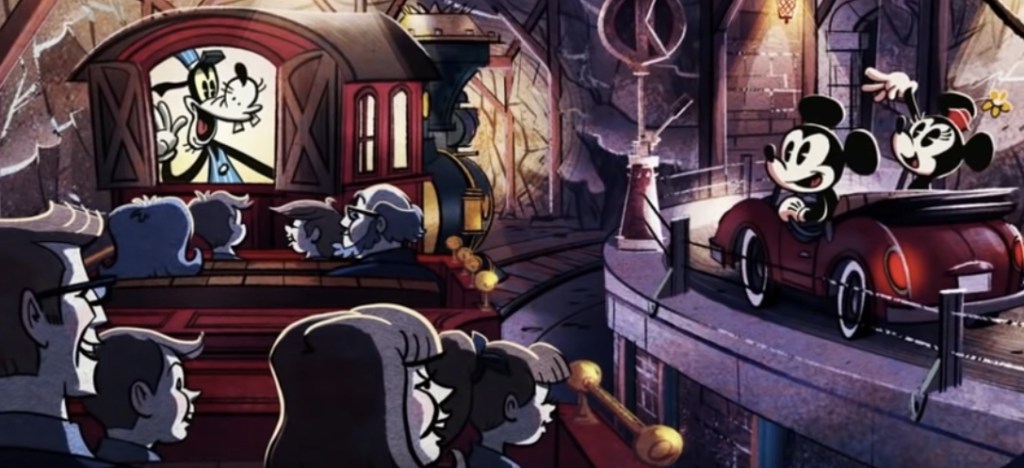
Some theme park attractions can seem irreplaceable, but even the most perfect and timeless rides eventually come to the end of their lifespan, and The Great Movie Ride was no different. The announcement that this beloved attraction would be closing came in July of 2017, to be replaced with a dark ride following the adventures of Mickey Mouse and friends, and a month later, the Great Movie Ride gave its final tour. The new attraction, later announced as Mickey and Minnie’s Railway, was planned to open in time for Hollywood Studios’ 30th anniversary, however this was not the case, and the ride was delayed for another year.

When the second planned opening date came around, in March 2020, the Runaway Railway- which was actually trackless rather than being on a railway-like track- did actually open, but even this grand opening wasn’t perfect. The 2020 pandemic put the whole world on hold, and with it the huge amount of fans wanting to try out Hollywood Studios’ newest attraction. Most people who have ridden it weren’t able to until after WDW reopened later that year… but for many, the ride experience proved worth the wait!

Mickey and Minnie’s Runaway Railway, aside from having a name that is actually pretty difficult to say quickly, came as a bit of a relief for those tired of too many IP’s in Disney parks. With an original storyline and starring the characters that started it all, Runaway Railway opened to pretty positive reviews- in both March and July, and for many is a worthy replacement to the fan-favourite that was there before.

The ride allows guests to jump into to the whimsical world of the classic Mickey Mouse cartoons, and hop aboard Goofy’s train for what seems like a relaxing journey through the countryside- but when Goofy flips the “track switch”, the trip starts to go a little, or a lot bit wrong.

Trackless chaos ensues as you explore a carnival, a city, and take a dance lesson with Daisy Duck, before peace is restored and your ride vehicles rejoin the train just in time to see Mickey, Minnie and Pluto enjoying a picnic and singing one of the extremely catchy original song Nothing Can Stop Us Know. It’s stuck in my head right now as I write this! If I got it stuck in your head too… I apologise. At least it’s not Small World!

In many ways Runaway Railway and The Great Movie Ride are pretty similar, in that they both allowed riders to explore a movie world (or in the latter’s case, several!) and both had conflict centred around a relaxing tour going unexpectedly and suddenly wrong. Plus, Runaway Railway is full of nods to its predecessor. In the carnival scene, you can spot a sign advertising “The Great Moving Ride”, and later on in the tornado scene, which in itself is a Wizard of Oz reference, there is a mailbox reading “no place like home”. It’s great how Disney leaves little Easter eggs to their rides and attractions of the past- it gives a unique touch to what are often already unique and magical experiences!

Did you ever get to experience The Great Movie Ride? Do you prefer GMR or Runaway Railway! Share your thoughts in the comments below!

If you enjoyed this article, check out my other posts from theme parks and attractions around the world, and find us on Instagram and Facebook!

Frozen vs. Maelstrom: the battle of the Norway Pavilion

Norway is a country of beauty, wonder and of course adventure, and this was represented incredibly well by the Norway Pavilion in Epcot’s World Showcase. The pavilion opened in June 1988, and for over 25 years remained largely the same, with a single darkride that brought the spirit of Norway to Florida, among other services…

Subscribe to have all the latest CoasterDreamers articles delievered straight to your inbox, so you’ll never miss an upload!

You are all clear… and outta here! Thanks for reading!

-Lily 🙂

We’re going to ride WHAT? Strange dark rides that will make you question the very fabric of reality

Dark rides have been a staple of theme and amusement parks from the beginning, so it’s no wonder that among the classic haunted houses and water-based pirate adventures, rides have popped up that put a completely new spin on the concept. From family rides and parks with not so family-friendly themes, to mesmerising sensory experiences that will leave you confused and awestruck, and even rides that have no theme at all, join me as I explore some of the strangest dark rides around the world!

Terminus, Travelling Fair Circuit

When you pay to ride a dark ride at your local travelling fair, you’d expect there to be theming, right? Well, if that dark ride is Terminus, you might need to lower your expectations. On first arriving at the ride, the façade is decorated with images of zombies, and every few moments a train can be spotted going down a little drop at the front of the attraction, but this hint at thrill and maybe a zombie haunted house theme is quickly lost as riders board the train. You begin this weirdly unique experience by climbing the lifthill, which boasts just one piece of theming: a zombie static figure glaring from a cage, but this is where the zombie theme, or any theme, for that matter, ends.

The remainder of the attraction takes riders on a gentle yet tedious journey through a series of metal hallways that on most rides would be filled with theming, but this is Terminus: there is no theming. After a while riders do get the thrill of dropping down a small dip and back up into the show building, and a winding ride on a Wild-Mouse style layout, but, with many people considering this the worst dark ride in the world, there really isn’t much going for Terminus.

Not much is known about the history of this unimaginative experience, but it did once operate under another name: Mouse Trap. This version of the attraction was a lot better themed- although there is section that is empty in both versions, the inside of the older ride is much more colourful, and has a defined theme that at least provided a bit of entertainment. Today there is absolutely nothing to look at other than metal walls, and very little to listen to other than the mechanical sounds of trains on a track, which in a way is pretty creepy- maybe there is a horror element to the ride after all!

Meow Wolf Kaleidoscape, Elitch Gardens

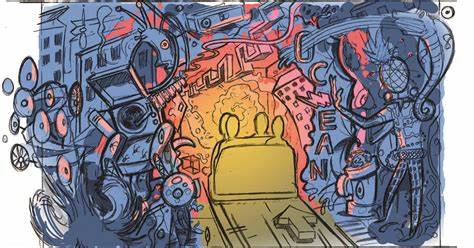
In a way, this new-for-2019 dark ride could be considered to be a polar opposite to Terminus- it’s bright, heavily themed and offers a truly immersive experience through a magical world of incredible lights and colours. Designed by New Mexico based arts group Meow Wolf, Kaleidoscape is described as “a thrill ride for the mind”, and it’s certainly that, creating a ride experience that is as mesmerising as it is confusing.

Riders begin the experience by travelling through an elaborately themed queueline, meeting a colourful, retro animatronic along the way who explains the storyline of the attraction, and informs you that the park is not responsible for “deformation of internal sense of deja vu” or a few other ‘risks’ that the ride could pose (which is slightly unsettling!).

Check out this awesome video from Meow Wolf promoting the ride! Warning for flashing lights and colours.

On entering the load/unload station, riders board their colourfully patterned ride vehicle and venture into the immersive world of Kaleidoscape, following a tiny speck of light on its journey to becoming a huge, bright being, passing by elaborate sets, theming and A LOT of flashing lights along the way! If ride design is considered a form of art, then this one is a dazzling, hypnotising masterpiece!

Body Wars and The Making of Me, Epcot

Disney theme parks are the lands of yesterday, tomorrow and fantasy, but there are some attractions that introduce a fourth factor into this: uncensored and slightly unsettling reality, and this is where Epcot’s ninth and arguably strangest Future World pavilion comes in. At first glance, it may seem like it would be pretty difficult to make a pavilion promoting the importance of looking after your mental and physical health weird, but somehow, Wonders of Life managed to pull this off, and it was weirder and in some cases more controversial than anyone could have anticipated.

Making its debut around seven years after Epcot’s opening day in 1982, Wonders of Life was housed inside a majestic golden dome nestled between Horizons (now Mission: SPACE) and Universe of Energy (soon to be Cosmic Rewind!), and was home to three main attractions, as well as a few smaller ones. The first of these, Cranium Command, was normal enough, taking guests on a journey into the mind of a 12 year old with ‘Cranium Commando’ Buzzy. It was a concept that had been around since the earliest designs for Epcot, when the attraction would have been called Brain Command and the Pavilion was named Life and Health. It proved to be a success- so much that someone actually stole the Buzzy animatronic back in 2018- but it was the other two, The Making of Me and Body Wars, that gave Wonders of Life the strangeness we know it for today.

At the time of its opening, Body Wars was considered the most intense and thrilling ride at Epcot, as well as the most disgusting, and that last legacy held true right up until its closure in 2007. The ride system was nearly identical to Star Tours in Disneyland and Hollywood Studios, except instead of flying through space with C3PO, you are flying through an unsettlingly realistic rendering of the inside of the human body. Combined with the roughness of the simulator, its no wonder people were having wars with their own bodies and trying not to re-meet their lunch.

But if getting up close and personal with the inside of your blood vessels wasn’t disgusting enough for you, just a few metres away you had the opportunity to learn how babies are made, likely sat alongside children whose innocence is being ruined, and plenty of mortified parents who had no idea what they were signing themselves up for.

Although not a dark ride, or even a ride really, this next attraction, The Making of Me, is just too obscure not to discuss. Housed inside a small theatre attached to the side of the dome, the film, starring actor Martin Short, showed guests the magic of conception and birth, starting with two teenagers meeting in high school, and eventually getting married going on a honeymoon, and having a child.

The most controversial part of the show however, was the segment right before the child is born, when a female egg and male sperm meet and- you can imagine the awkward conversations that went on between parents and kids after that experience. To be fair, there was a sign outside the theatre warning that some uncomfortable topics will be explored, but many were still taken by surprise nonetheless.

In its earliest years of operation, Epcot really did have some strange attractions, from the slightly strange and unique, to the how-and-why-did-this-make-it-into-a-Disney-park levels of weirdness, and while Cranium Command may have fallen into the first category, there’s no denying that Body Wars and The Making of Me fit firmly into the second. Over the years, as MetLife failed to renew their sponsorship of Wonders of Life, and newer experiences opened up across the park, the pavilion began to decline in popularity, and its three attractions fell into disrepair. Wonders of Life officially closed in January 2007, and for over ten years was standing but not operating, occasionally being used as a festival centre, but mostly just standing but operating.

In 2019, it was announced that Wonders of Life would receive a complete reimagining as the PLAY pavilion, themed as a futuristic city modelled off of Ralph Breaks The Internet’s representation of the Internet. Although it is amazing to see updates and rethemes coming to old, iconic rides and pavilions, it’s still fun to take a look back in time at the strange rides of the past!

The Cremator, Window of the World

If asked to think of morbid and creepy dark rides, what comes to mind likely doesn’t stray too far from the iconic Haunted House type attractions we see at many of our favourite theme parks, but while haunted houses explore the idea of afterlife, ghosts and ghouls, there is one ride, located at Window of the World in Shenzen, China, that goes one step back from that and quite literally simulates death.

The attraction, simply and bluntly named The Cremator, somewhat stands out in Window of the World, which is pretty family-orientated with a focus on worldwide travel and exploration, kind of like a combination of Europa Park and Epcot (just without the giant geodesic spheres!). But if Epcot can have its share of weird attractions (I’m looking at you Wonders of Life!) so can this park, and they have certainly taken up this opportunity.

Riders, whether unsuspecting or knowledgeable about the horrors that await, enter a dingy mortuary filled with plastic body parts that look scarily realistic, and soon lie down in wooden coffin ride vehicles, ready to do exactly what the ride’s name says: be cremated. Or at least, simulate getting cremated- the ride hasn’t actually killed anyone. You then travel through a brick archway and into the fire, soon emerging from the chamber after a while, not quite cremated, but definitely shaken from having just simulated the ultimate doom.

At this point you may be wondering why on earth someone would want to feel as if they are being burnt alive (I know I wouldn’t!), but The Cremator does actually serve a larger purpose than creating nightmares: it is designed to make people feel less scared of death! According to some riders, it really works, while according to others not so much. Speaking to the Mail Online, who did a story on this ride back in May 2015, those who didn’t have the most enjoyable experience said “it was horrifying” and that they are “never coming back”. But some had more positive things to say, telling the news outlet that it was “quite good fun”. I guess your enjoyment of this ride depends on how much you want to experience a very different kind of thrill at a theme park.

Although designing a ride simulating what many people fear most may seem like a daunting task requiring the very best in theme park technology, the tech used to create this experience is actually quite simple: lighting effects create the fire, while air blasted at 40°C is used to create the feeling of burning. I suppose this just goes to show how the most simplistic of rides can sometimes be the most terrifying!

Original Alice in Wonderland Ride, Disneyland

Alice in Wonderland: the classic but slightly strange film following the adventures of seven-year-old Alice, as she tumbles down a rabbit hole and into the wacky world of Wonderland. Seems innocent enough, right? And you’d likely expect a ride centring around the 1951 movie to share this innocence, but, if we’ve learned anything from this post, it’s that if anything in a theme park seems innocent and family-friendly, there’s probably something proving it isn’t, and unfortunately, the original version of Disneyland’s Alice in Wonderland dark ride is no different.

Ever since Disneyland’s early planning stages, there were plans for some kind of Alice in Wonderland attraction. Originally it was set to be an elaborate walkthrough maze, allowing guests to travel through the scenes of the film, but this was quickly scrapped with the hope that it could come to fruition at some point in the next decade. Budgeting was a huge problem when Disneyland was being constructed- balancing creativity with limited amounts of money was and still is quite difficult to do- leading to much of the original plans being cut or drastically reduced, and the Alice in Wonderland walkthrough was one of many to be put away for a few years. The 1951 animated film did have a presence in Fantasyland, with Mad Tea Party opening with the park in 1955, but by the time of the 1958 Fantasyland overhaul, and with all of the magical new renovations there was a perfect opportunity to revive the shelved concept.

After some deliberation it was decided that, instead of a maze, the the attraction should come in the form of a dark ride built on the top floor of Mr Toad’s Wild Ride’s show building (if you break down on Mr Toad’s and the audio is switched off, you can sometimes hear parts of Alice in Wonderland’s audio from upstairs!). By doing this, it was hoped that it would combat the problem of guests loitering in a few areas of the walkthrough and increase capacity for the attraction. The concept of an Alice in Wonderland maze wasn’t abandoned completely however- you can still explore Wonderland at your own pace in Alice’s Curious Labyrinth at Disneyland Paris!

Imagineers worked hard to bring the nonsensical world of Wonderland to Disneyland, and they succeeded, bringing to life many of the scenes both from the movie and from the maze, as well as some new scenes that likely left riders very confused. After an elaborate opening ceremony featuring Alice and a slightly terrifying White Rabbit, guests were greeted by a whimsical ride façade hinting at a magical adventure inside. The actual ride however, was a lot less whimsical, and the magic it offered certainly wasn’t the usual family-friendly Disney magic we’re used to.

The experience started off normal enough, with guests boarding their giant caterpillar ride vehicle and gliding up a twisting vine up into the show building. The inside, however, was where it got really weird. In one of the first scenes a rather creepy Cheshire Cat would stare you down, laughing maniacally with an easily visible speaker right in the middle of its gaping mouth. (Was there really nowhere else they could have put the speaker?)

Later in the ride, guests would attend the Mad Tea Party, which certainly lived up to its name, and definitely wasn’t the Happy Unbirthday you’d expect from a Fantasyland ride. The Mad Hatter and March Hare, with insane looks on their weirdly purple faces, would scream at unsuspecting, innocent riders and call them rude, before becoming so annoyed at the guests for doing absolutely nothing that they attempted to kill them with an exploding Unbirthday cake. Death was actually quite a common subject for early Disneyland dark rides to tackle, with both Snow White’s Scary Adventures and Mr Toad’s Wild Ride featuring a death scene close to the end of the attraction.

If you survived that horrifying experience, there was one more moment of fear before you could escape the Rabbit Hole. Your caterpillar takes you crashing though a set of doors themed as livid Playing Card guards, complete with Goofy’s agonising screams of terror blasting in the background. To be honest, I wouldn’t be surprised if Goofy wasn’t the only one traumatised by this ride- it truly would have been a petrifying experience!

The ride remained largely the same until the early 1980s, when Fantasyland was in need of another overhaul, to make it more relevant to families at the time, and to make it a bit of a less terrifying place to be. Many of the land’s dark rides got some kind of refurb to reduce the fear factor, but Alice In Wonderland received a complete reimagining, mostly involving removing the more frightening scenes and replacing them with something a little more kid-friendly.

The new version opened with New Fantasyland in 1983, allowing riders to fall down the rabbit hole with Alice without getting nightmares, with a slightly longer ride experience, and widened vines at the beginning of the ride as a safety measure. Today the ride is relatively similar to that 1983 version, but updated with some newer technology to create an immersive experience for all the family! Let’s just hope no one ever has to hear Goofy screaming in agonising pain and terror on a Disney ride again.

Have you ever ridden any of these bizarre attractions? What’s the weirdest ride you’ve ridden? Let me know in the comments below!

If you enjoyed this article, be sure to check out my other posts from theme parks and attractions around the world, and follow us on Facebook and Instagram for exclusive CoasterDreamers content!

Tall and Speedy: the story of the Intamin Accelerators

There was a time when lifthills were not just commonplace on coasters; they were compulsory for a working ride. A train travelling up a lifthill was the only way to gain enough momentum to complete the circuit- that was, until 1978 when Montezooma’s Revenge opened at Knotts Berry Farm in California, the first coaster to…

Keep reading

Subscribe to have all the latest CoasterDreamers articles delivered straight to your inbox!

You are all clear… and outta here! Thanks for reading!

-Lily

Coasting Through the Hills- the best almost-mountain coasters across the world

When you think of classic theme park icons, what comes to mind is probably along the lines of old-timey streets leading to enchanting fairytale castles, pirate ships hinting at elaborate adventures, and runaway trains coursing through some kind of mountainous or rocky terrain. Sure, these towering mountains weren’t exactly created by Mother Nature, but the combination of carefully crafted rockwork, elaborate storytelling and track that winds through every twist and turn makes for an experience that even real-life alpine coasters can’t match, and have become commonplace in a range of large theme parks across the world.

Board your mine train car, pull down your restraint and join me as we explore the some of the “wildest rides in the wilderness” at our favourite parks throughout the world!

Matterhorn Bobsleds, Disneyland

“One thing is for certain, as long as human nature draws people to mountains, Imagineering will continue to build them!”

Tony Baxter, Senior Vice President of Creative Development, Walt Disney Imagineering

Where better to start off this list than at the park that started it all? Disneyland let down its castle drawbridge to welcome guests on 17th July 1955, and after a rocky opening day, (learn more about this by checking out the post linked below!), grew to become one of the most well-known attractions not just in North America, but around the world. Walt Disney and his Imagineers were pioneers for many of the things we consider iconic to theme parks today, including the very concept of theme parks in general, but when the decision was made to open the parks’ first ever rollercoaster in the late 1950s, it’s unlikely anyone could have predicted the impact it would make.

Click below to take a trip back to Disneyland’s disastrous opening day of 1955!

Disneyland’s Black Sunday: What was it and how did it happen?

“As long as there is imagination left in the world, Disneyland will never be complete” Walt Disney When you think of Disneyland, what comes to mind? Castles, family, and Mickey Mouse? What about fires, dehydration and stampeding crowds? Okay, those last three maybe aren’t so likely. But all these actually happened on Disneyland’s opening day,…

The new coaster would be constructed on the former site of Disneyland’s Holiday Hill, which had become a spot for teenagers to do some, well, not very magical things while their younger siblings were enjoying the park, and would give these teenagers something a little more family-friendly to do at the Most Magical Place on Earth. But not only did the project expand the target audience for the park, it also expanded the offerings of the rollercoaster market and left a lasting impact on the industry. Up until this point rollercoasters had been built only of wood, but with it’s new-for-1959 coaster, Disneyland brought steel into the world of coasters!

Walt Disney consulted ride manufacturer Arrow Development, who had built many of Disneyland’s other early attractions, and work soon began on Matterhorn Bobsleds, the world’s first tubular steel rollercoaster, housed inside a huge, fibreglass replica of the Matterhorn mountain in Switzerland! Matterhorn Bobsleds first opened on June 14th, 1959, simulating the experience of riding a bobsled through one of Europe’s most famous mountains. Although riders don’t actually sled through real snow like Walt Disney first envisioned, the experience is made authentic by the incredible rockwork makes up the attraction, as well as an intimidating animatronic yeti that probably isn’t as iconic as the one on Expedition Everest, but still an integral part of the ride nonetheless.

Some riders say that over the years, Matterhorn Bobsleds has become a rough and uncomfortable ride (though maybe this adds to the authenticity of riding a bobsled!), but, painful or not, this revolutionary mountain coaster is still a classic part of the Disneyland experience, and continues to pave the way for a range of other rockwork-based attractions around the world!

Wonder Mountain’s Guardian, Canada’s Wonderland

Canada isn’t exactly known for its major theme parks, and didn’t actually have any big parks until Canada’s Wonderland opened in 1981. At the time of its construction, many locals were strongly opposed to the project, then called Paramount Canada’s Wonderland, concerned that the park would be damaging to the area and bring in unwanted aspects of US culture. Still, construction continued as planned, and Paramount Canada’s Wonderland first opened its doors in the early 1980s, welcoming 12,000 visitors with a grand opening ceremony containing 10,000 balloons, 13 parachutists and over 300 doves.

Today, and even when it opened, Canada’s Wonderland puts some of the US’s major parks to shame in the way of theming and providing an immersive experience for all the family, and this begins even as you first enter the park. Just behind the front entrance, visitors are greeted by a flowerbed arranged to resemble the Canadian flag, and a long fountain leading up to the park’s equivalent of Cinderella Castle at the end of Main Street, a large synthetic mountain named Wonder Mountain!

Wonder Mountain is the icon of Canada’s Wonderland and the first thing that catches your eye as you enter the park, but this isn’t the only thing that makes this stunning piece of theming so special. As you’re probably expecting from the title of this post, Wonder Mountain is home to a rollercoaster!

Plans for a ride housed inside the mountain had been brewing among park officials since 2004, when the success of Scooby Doo’s Haunted Mansion (now Boo Blasters!) had led National Amusements, who owned the park at the time, to consider building another interactive dark ride.

For a number of reasons the plans never came to fruition. That was, until 2011, when a new dark ride began planning and production for Wonder Mountain, and this time it would be more thrilling and more interactive than the plans in 2004 could have dreamed of. In late July 2013, the most observant fans of the park spotted construction work taking place on the Western side of the Mountain, and it wasn’t long before Cedar Fair, who had owned the park since 2006, officially announced what was being built inside the park’s icon. Wonder Mountain’s Guardian was revealed on Toronto’s breakfast news show Breakfast Television in August 2013, and further exciting details about the attraction at IAPPA of that year.

Although incorporating some aspects of the interactive dark ride it was originally meant to be, Wonder Mountain’s Guardian introduced a new element to the concept: thrill. Riders join King Adelsten as he comes to the mountain to fight the dragon Omarr, and it isn’t long before the King loses his hat, and needs your help to retrieve it. You can do this by shooting the ride’s built-in laser guns at the surrounding screens, and soon your train takes you into an underground city known as the Draconian City in an attempt to escape from the evil dragon, and as a drop track lowers you and your fellow riders out of the city, you coast down a 30ft drop back into the station.

What makes Wonder Mountain’s Guardian truly unique is that each part of the ride experience offers something for almost every kind of rider- thrillseekers can get their dose of screams on the drop, the competitive ones in your group can compete to get the highest score and earn their place in the “Wonder Mountain’s Guardian Hall of Fame” and those who love detailed storytelling can get their fix too!

Expedition Everest, Animal Kingdom

Now let’s take an ‘expedition’ to Walt Disney World’s forth and newest theme park, Disney’s Animal Kingdom! This incredible park was the brainchild of Imagineer Joe Rhode, who wanted to create a theme park centring around the magic of nature and the importance of conservation, and today you can get up close and personal with their favourite animals on Kilimanjaro Safaris, experience the story of the Lion King with an energetic musical performance, and glide on the back of a banshee in Pandora (if you can bear to wait in the endless queue!), but there is one attraction has been an icon of the park since its opening, and that is Expedition Everest. Well, the ride’s full name is Expedition Everest: Legend of the Forbidden Mountain, but that’s a bit of a mouthful and Expedition Everest sounds better on its own anyway!

By the early 2000s, Animal Kingdom had been entertaining guests for several years, and although there were plenty of great attractions at the park, there had yet to be something that truly blew guests (and the loose articles some people bring onto rides!) away. This would come in the form of a record-breaking new rollercoaster, that didn’t exactly break the boundaries of what coasters could do, but really pushed the limit of how just far a theme park would go in order to create immersive experiences for its visitors.

Construction on the project began soon into the early to mid 2000s, after Imagineers took real -life adventures to the Himalayas to gain inspiration for the project, and at the back of the park’s Asia section, the framework for a rockwork mountain could be spotted getting taller and taller. The mountain would become Disney’s tallest ever artificial mountain to date, and one of the largest structures in Walt Disney World as a whole, at 199.5ft- buildings in the area cannot be built over 200ft without having a little warning light at the top to warn planes! However, the track goes a little lower at 112ft.

The ride was officially announced as Expedition Everest: Legend of the Forbidden Mountain on 22nd April 2003, a Vekoma custom family coaster taking riders on a thrilling journey through a mountain oddly not modelled after Mount Everest- it is the fictional Forbidden Mountain instead!

In February of 2006, two months before Everest’s opening, Disney launched a massive publicity stunt in New York’s Times Square. Five acrobats and a rock climber from the dance company Project Bandaloop took over the square performing twists and twirls high above the ground, and this show was named Everest in the City. It certainly brought more attention to the rollercoaster that would open in Animal Kingdom just a few months later, and when Expedition Everest opened to the public, it was a huge success.

Expedition Everest takes guests on a thrilling journey through the heights of the Himalayas, first taking you through an elaborately designed queueline, then on a slow climb up the lifthill. Riders twist and turn through Everest’s theming, but, just as you think your journey might be normal and uneventful, you reach a stop in the ride where the track has been broken and warped, and you are sent cascading back into the mountain where you come face to face with a giant audio-animatronic yeti that tries to pounce on you and rip up the track in its anger.

The track isn’t the only thing the yeti seems determined to destroy though, as when it is in its full functioning state, or A-Mode, it can be seriously damaging to the mountain. In March 2009, less than years after its opening, cracks were found in the mountain’s foundations, which, if left unattended to, could have posed irreparable damage to the ride. It was soon discovered that, likely due to its weight and large movements, the yeti animatronic was what was causing this damage, and the decision was made to put the yeti into B-Mode, so that it would not place any more unnecessary stress on Everest’s foundations.

Today, the yeti uses strobe lighting to make it seem as if it really is going to tear apart the track, earning it the nickname Disco Yeti. At 2013’s D23 Expo, Joe Rhode swore that he would fix the yeti, but eight years later no work has been done on the attractions, so it looks like this disco-dancing audio animatronic will continue to look fabulous in its strobe lighting until further notice!

Big Thunder Mountain, Disneyland Paris

Since 1979, there has been a certain coaster that practically defines Disney’s theme parks, and that is Big Thunder Mountain Railroad. At the time of its opening, mine train coasters were rapidly growing; Arrow Dynamics were blazing the trail for a new market of rollercoasters, which instead of thriving to be the tallest, fastest, or have the most inversions, would be aimed at a different audience: an audience looking for a slightly lower level or thrill, or who couldn’t quite reach the height requirement to ride the larger coasters yet. Many parks installing Arrow Mine Trains would go the extra mile with theming, crafting elaborate stories to entertain riders as they twisted, turned and dipped through the ride.

When Disneyland jumped on the mine train trend, they went all out, replacing the much more relaxed Mine Train Through Nature’s Wonderland with an exhilarating adventure through the fictional town of Rainbow Ridge, and it wasn’t too long before the new rollercoaster, named Big Thunder Mountain Railroad, became an icon of Frontierland, and of Disneyland itself. The other Disneyland-style park that existed at the time, Magic Kingdom, received a version of the coaster just a year later in 1979, and when Tokyo Disneyland and Disneyland Paris opened later on, they also received versions.

Fast forward to the early 1990s; Imagineering were creating plans for the first and only European Disney park, and they knew it needed to be something special, for a completely different audience. It was decided that the classic formula for the traditional Disney parks should be completely reimagined- particularly in Fantasyland, which with its old European-style architecture wouldn’t appeal as much in Europe, and Tomorrowland, which quickly and consistently outdates itself and becomes the land of past rather than the future. Euro Disneyland opened in April 1994 as what is arguably the most beautiful Disney park in the world- every detail had been given meticulous attention and design, and, while it wasn’t too different from its original inspiration, Frontierland was given a lot of thought, and a lot of imagination.

In most parks with Frontierland as one of their main themed lands, Big Thunder Mountain is surrounded by other attractions, such as Splash Mountain in Magic Kingdom, or the Mark Twain Riverboat in Disneyland, meaning that while it still is a massive part of the land, it may not be what your eyes are drawn to when your first enter the land. Paris’ Frontierland is designed in such a way that everything centres around the rollercoaster, sure, there are other attractions in the land, but having been built on an island in the middle of the Rivers of America, Big Thunder Mountain is impossible to miss. This genius design builds up the excitement as you walk through the land and experience everything else it has to offer, so that after a while you will be super excited to ride “the wildest ride in the wilderness”!

Lost Coaster of Superstition Mountain, Indiana Beach

This unique rollercoaster-darkride hybrid may not be as well known as the other rides on this list, but it certainly has more to offer than its extremely long name and odd looking ride trains that look as if they’ve been taken straight from a fairground ride. Superstition Mountain made its debut in 1978, as a dark ride taking riders on a magical journey though the mountain, which was adorned with tunnels and special effects. There was one problem however, and that was the technology of the ride actually working. Due to the track being electrically powered, Superstition Mountain could not operate in the rain, leading to a LOT of downtime, and by the 2000s Indiana’ Beach’s owner at the time, Tom Spackman Jr, decided something needed to be done- and that something came in the form of a major renovation that would change the very nature of the attraction.

2001 marked the beginning of the reimagining, as employees began disassembling parts of the attraction to prepare for the refurb that would take place the following year. At the time, Custom Coasters International were one of, if not the biggest manufacturer of wooden coasters out there, having built attractions like Boulder Dash at Lake Compounce and Ghostrider at Knotts Berry Farm, but this new project was completely different- taking an existing ride, and turning it into an action-packed rollercoaster that would deliver the same level of thrills of many other of CCI’s rides. I guess you could say it was similar to a coaster being RMC’d, before RMC was even popular! CCI took the challenge in their stride however, and certainly did not fail to deliver, creating a coaster with some seriously tight twists and turns that put even some of the world’s most intense rides to shame!

The new coaster, named Lost Coaster of Superstition Mountain, was announced at a media event in May 2002, as a unique type of rollercoaster taking riders on a much more thrilling adventure through Superstition Mountain, with the original rider-driven cars being altered in favour of an elevator lift at the start of the ride. Around a month later in June, the coaster began operation, and has remained one of the more popular, if obscure, rides at the historic park ever since. Just like “there’s more than corn in Indiana”, there’s certainly more to Indiana Beach than lakeside views and fairground rides!

Check out my post exploring the detailed history of Indiana Beach, from its opening as a small boardwalk park to a thriving theme park, by clicking below!

Indiana Beach: A little park with a lot of history

From it’s origins as Ideal Beach in 1926, Indiana Beach has entertained and thrilled visitors for almost 100 years. This small boardwalk park is located on Indiana’s beautiful Lake Shafer, and has previously been home to over twenty rides and attractions, aimed at families and thrillseekers alike. On February 20th 2020, Apex Parks announced the…

Honourable Mention: Mount Prometheus, Tokyo DisneySea

This magnificent mountain doesn’t really fit in with the other attractions on this list, but with its 75,000 square feet of rockwork, and immaculate detail and theming, it’s just too impressive not to mention! Mount Prometheus was in the plans from the very beginning, when a version of the park was going to be built in Long Beach, California, though the mountain wouldn’t have been as impressive, and likely not a park centrepiece.

The project, named Port Disney, was never carried out, but when it was decided that it would instead be built as a neighbouring park to Tokyo Disneyland, the Oriental Land Company, who operate the resort, decided that Mount Prometheus should be a much more majestic and dominating presence in the park, leading to the construction of the mountain fans know and love today.

Mount Prometheus is one of the first things you see when you enter Tokyo’s second Disney park, standing as the centrepiece of Mysterious Island, a themed land mostly revolving around the history of Jules Verne’s novels, and acting as a kind of portal to Mediterranean Harbour, where it provides a stunning backdrop. While each of the mountains on this list are home to just one attraction, this one is home to two, and they aren’t small walkthrough attractions either: 20,000 Leagues Under the Sea and Journey to the Center of the Earth are both hugely popular rides, attracting massive queues from guests wanting to experience the magical worlds the rides bring to life.

Rides aren’t the only thing the mountain is known for however: Mount Prometheus is the only Disney mountain that isn’t actually a mountain- it is actually a volcano, and just like a real active volcano, it erupts! Ten major rocket boosters each weighing 3000 pounds, or 1361 kilograms, launch flames up to fifty feet into the air, making you feel as if you are witnessing a real volcanic eruption.

Tokyo DisneySea is arguably one of, if not the best, themed Disney parks in the world, and, like the park it is located at, Mount Prometheus is the perfect example of what can be when creativity is allowed to run wild!

What’s your favourite ride or rollercoaster built into a rockwork mountain? Do you prefer thrills or theming on a rollercoaster? Let me know in the comments below!

A massive thank you to @wewereinverted_ig and @happiesthollie on Instagram for the photo permissions- it was a huge help! Check them out here:

H O L L I E 💗 (@happiesthollie) • Instagram photos and videos

Patrick | We Were Inverted (@wewereinverted_ig) • Instagram photos and videos

Home | We Were Inverted | Roller Coaster Hang Out

If you enjoyed this article, check out my other posts from theme parks and attractions around the world, and find us on Instagram and Facebook for exclusive CoasterDreamers content and updates on the latest blog posts!

X-Sector: a history of the sinister side of UK theme parks

The UK is home to some incredible family theme parks and attractions, offering tame thrills and immersive adventures for all ages. But the theme park scene here isn’t just for young families- there are some parks that offer themed lands that are a lot darker than you’d expect from a park with a Cbeebies Land…

Keep reading

Europe’s Greatest Darkrides- one continent, many amazing worlds

Europe is home to many incredible darkrides, from the thrills of indoor rollercoasters, to the beauty of many of the scenes in some trackless and water-based darkrides. Not all rides are created equal however, and some parks go all out with creating the most immersively impressive darkride experiences for their guests, combining technology, story and…

Keep reading

Subscribe to have all the CoasterDreamers articles delivered straight to your email inbox!

You are all clear… and outta here! Thanks for reading!

-Lily 🙂
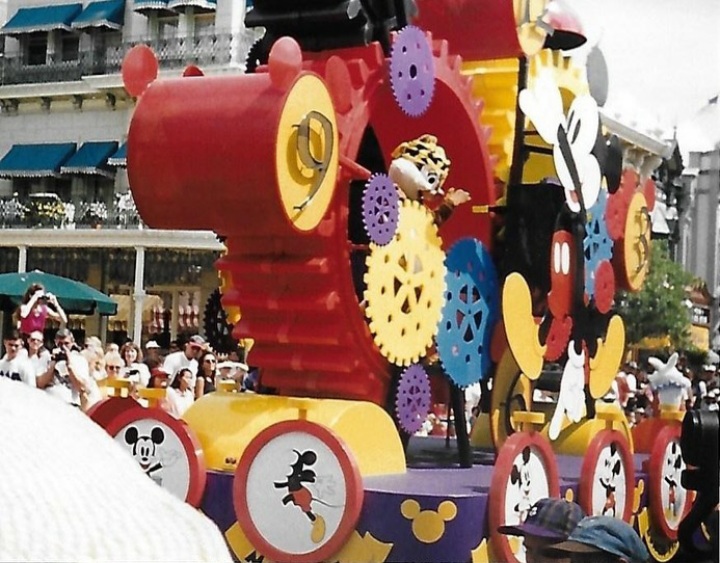
Herschend Family Entertainment: 26 Magical Experiences, One Family Company

When you think of the most famous theme park chains in North America, you likely think of the likes of Cedar Point or Six Flags, but in the theme park world, sometimes the best things come in small packages, and Herschend Family Entertainment, based in Atlanta, Georgia, is a prime example of this.

Owning just four theme parks and three water parks, as well as some other attractions, Herschend Family Entertainment dates back to the acquisition of a mountain attraction in 1951 and today offers some of the best themed experiences in the world. Herschend has recently acquired Kentucky’s main theme park, Kentucky Kingdom, so what better time to go back to where it all began and explore the history of this small but popular chain that “creates memories worth repeating”!

From a Holiday to a Business

Back in the early 1950s, Hugo and Mary Herschend, and their two sons, travelled from their home in Illinois to the Ozark Mountains in Missouri on a family holiday, and while they didn’t know it at the time, this holiday was the beginning of something huge. The family fell in love with the area with the enchanting atmosphere and nature the area had to offer, and it wasn’t too long before they had bought out a mountain-based attraction called Marvel Cave, and the process of transforming it began.

Tragedy struck when Hugo Herschend died from a heart attack a few years later, but this didn’t stop the family, and a decade later Mary Herschend, along with her sons and seventeen staff, opened a small 1800s village attraction on the Marvel Cave grounds. The town would eventually be named Silver Dollar City (which soon grew into the park many of us know and love today!), and this formed the basis for what would eventually come to be.

The company began its life as Herschend Enterprises and soon became involved in the crazy and thrilling world of theme parks, starting around twenty years later with the obtainment of a park that may not have been much when it opened, but is now one of the most popular parks in the US.

The Newest Theme Park

By the 1970s, Silver Dollar City was thriving, and, as the theme park business in the US grew, so did the park’s offering. 1972 brought the addition of the park’s first rollercoaster, Fire in the Hole, an obscurely named indoor coaster themed around the burning of a village in the Ozark Mountains in 1800, built in-house by the park themselves. This thrilling adventure back in time was one of the first examples of a ride inspired by the history of the local area, paving the way for a multitude of other locally themed experiences, such as Hex at Alton Towers, and California Screamin’ (now Incredicoaster) at Disney California Adventure!

Nine years later American Plunge made a splash at Silver Dollar City, as a log flume built by Minneapolis based firm Barr Engineering. Throughout the 60s and 70s, and at the time of American Plunge’s debut in the 1980s, the log flume was the ride to have for theme parks across the world, after Arrow Development’s invention of the attraction in 1963, and, although some classic log flumes are closing to make way for newer, more modern ride, the remaining log flumes still remain popular, and American Plunge continues to soak and thrill riders to this day.

1985 meant the opening of another water ride, Lost River of the Ozarks, themed to the local area similar to Fire in the Hole, although the Lost River would only last until 2018, when it was demolished to make way for a new water ride, Mystic River Falls, which opened in Summer of last year.

Silver Dollar City was experiencing a growth in both ride lineup and park attendance as word spread about the park during the 70s, and the park continued to grow and gain popularity in the decades following. Things were looking great for the park, and for Herschend Enterprises as a whole, so, by 1976, it was time for something new.

The Second Silver Dollar City

Rebel Railroad opened its doors as a small park owned by the Robbins Brothers, where guests could travel back in time to the American Civil War, visiting a saloon, a blacksmiths, and general store, as well as experiencing an attack on an old-fashioned steam train. The park changed its name to Goldrush Junction, after being obtained by Art Modell in 1970, and the lineup was expanded- with an outdoor theatre, a log flume, and, somewhat bizarrely for a theme park, a church.

The park was finally bought out by Herschend Enterprises in 1976, who shortened the name from Goldrush Junction, to just Goldrush for that season. A year later Goldrush was renamed Silver Dollar City, and not only did the name change, the park grew to become more and more like the original park in Missouri, but with a Tennessee twist. Just two years after Herschend’s acquisition of the park, they opened the first rollercoaster at Silver Dollar City Tennessee since Scamper’s closure in the early years of the decade: Blazing Fury, an indoor rollercoaster very likely inspired by Fire in the Hole, built by the park’s maintenance and construction team.

Similar to the original Silver Dollar City undergoing growth in the early 1970s, Silver Dollar City Tennessee opened a range of new attractions in the later years of the decade, as well as in the 1980s, from a Waveswinger called Swingmajig in 1980, to Thunder Express, an Arrow Mine Train in 1989, and the park soon became one of Tennessee’s most popular attractions. It wasn’t too long until the the park’s name was changed once again, to Dollywood, in 1986, after Dolly Parton purchased a stake in the attraction.

The well-known country singer grew up in the Pigeon Forge Tennessee area, and had said that if she ever became successful, she would return to her “part of the country” and “do something great”- and she certainly did: today Dollywood is the largest employer in the area, and brings tourists from miles around to explore its retro theming, and thrilling attractions, such as Tennessee Tornado, Mystery Mine, and the revolutionary Lightning Rod!

Not Much to Celebrate in Missouri

While things were going well for Herschend in Tennessee, in Missouri things weren’t as good. Branson USA, a ground-up theme park that opened in 1999, had struggled since its opening, and it was hoped, that the company would be able to help the park rise from the ashes, renaming it Celebration City for the 2003 after a $40 million reimagining of the attraction (not to be confused with Disney’s ‘perfect town’ Celebration Florida, a topic for another post!). The plan was for the new Celebration City to continue the story created by Silver Dollar City, and become a sister park to the original Herschend attraction, but sadly, unlike the original, Celebration City never really took off in the way it was expected to.

The park continued to struggle financially, and, by 2008, Herschend were left with no choice but to complete the 2008 season and announce that it would not return for 2009. Some of Celebration City’s attractions were relocated to other parks, while others simply remained abandoned, now a hotspot for inquisitive locals and tourists alike, wanting to explore what once was.

The Next Expansions

For several years after Dollywood’s partial reimagining in 1986, Silver Dollar City and Dollywood, as well as the dinner show chain Dolly Parton’s Stampede and the water park White Water Branson, remained as Herschend’s only assets, but by the mid to late 90s, the time had come for expansion once again. The company debuted the Showboat Branson Belle in 1995, offering relaxing views of Missouri’s Table Rock Lake, and began management of the Stone Mountain National Park in Georgia just three years later in 1988.

By 2007, Herschend had once again solidified their place in the amusement and water park business, as well as coming back from the financial struggles of Celebration City, which would close a year later. The chain Adventure Parks Group had recently gone bankrupt, along with their various parks including Wild Adventures in Georgia, and Herschend took the opportunity to add the zoo theme park, as well as its sister water park, Splash Island, to its attraction lineup, where they gave them the unique treatment they had given to Dollywood on purchasing- removing some rides, and adding others such as Viking Voyage, Whirling Wildcats and Falcon Flyers. The three new attractions had three things in common: each being relocated from Celebration City, and each having a lot of alliteration in their names!

Over the years, Wild Adventures and Splash Island would continue to see their attraction lineups expanded, and the parks still operate to this day!

A New Kingdom, and a Bright Future

Around a week ago, the theme park world heard some big news: Kentucky Kingdom, along with its sister water park Hurricane Bay, would be purchased by Herschend Family Entertainment, ready to reopen for the beginning of the beginning of the 2021 season.

Similar to some of the other attractions Herschend operates, Kentucky Kingdom has struggled financially in the past, being closed by Six Flags due to bankruptcy in 2010, and remaining SBNO until finally reopening in 2014. The park has been on the path to greatness since its reopening, with the opening of coasters Lightning Run, Storm Chaser and Kentucky Flyer all in the last seven years, and some pretty amazing social media marketing, and there’s no doubt Hershend will add a few extra touches to really help the park in becoming even more popular in the next few years!

What are your thoughts on the announcement? Let me know in the comments below!

If you enjoyed this article, check out my other posts from theme parks and attractions around the world, and be sure to find us on Facebook and Instagram for plenty of exclusive CoasterDreamers content!

Indiana Beach: A little park with a lot of history

From it’s origins as Ideal Beach in 1926, Indiana Beach has entertained and thrilled visitors for almost 100 years. This small boardwalk park is located on Indiana’s beautiful Lake Shafer, and has previously been home to over twenty rides and attractions, aimed at families and thrillseekers alike. On February 20th 2020, Apex Parks announced the…

Jaws: the thrilling history of an iconic Universal attraction

In the 1990s and 2000s, few rides summed up the iconic Universal Studios experience like the classic opening day attraction Jaws. One of the first attractions a guest would see as they entered the park, Jaws combined exhilarating thrills with immersive theming and of course the very real possibility of getting soaked (it was a…

X-Sector: a history of the sinister side of UK theme parks

The UK is home to some incredible family theme parks and attractions, offering tame thrills and immersive adventures for all ages. But the theme park scene here isn’t just for young families- there are some parks that offer themed lands that are a lot darker than you’d expect from a park with a Cbeebies Land…

Consider subscribing to have all the latest CoasterDreamers articles delivered straight to your inbox!

You are all clear… and outta here! Thanks for reading!

-Lily 🙂

X-Sector: a history of the sinister side of UK theme parks

The UK is home to some incredible family theme parks and attractions, offering tame thrills and immersive adventures for all ages. But the theme park scene here isn’t just for young families- there are some parks that offer themed lands that are a lot darker than you’d expect from a park with a Cbeebies Land Hotel, and is owned by the same company as Legoland Windsor and Chessington World of Adventures… that’s right, I’m talking about Alton Towers, and specifically X-Sector.

Tucked away in the corner of the park, this themed land that first made it’s debut in the late 90s offers two heavily themed coasters as well as a Huss Enterprise (creatively named Enterprise!), loosely tied together by the theme of a mysterious industrial site that is possibly the site of a secret government organisation. Let’s take a trip to the Ministry of Joy and explore the history of X-Sector- just remember to Smile Always and Don’t Look Down!

Check out another of my posts to learn more about Alton Towers’ Secret Weapon coasters!

Alton Towers’ Secret Weapon Programme: what is it and how does it work?

Alton Towers is considered to be one of the most amazing theme parks in the UK and even in Europe, with many coaster enthusiasts making the park a bucket list location to get some awesome creds. Nestled among some beautiful scenery and historic locations in Staffordshire, England, Alton Towers is home to some incredible rides,…

From Fantasy to Horror

Alton Towers opened its doors in 1980 and has been developing and changing ever since. In its earlier years the park was predominantly family-orientated, allowing visitors to go Around The World In 80 Days, and get completely drenched on the Flume and Grand Canyon Rapids, but every few years a new coaster was added that would pave the way to the Towers becoming the thrill park we know it as today. Corkscrew was, as you can imagine, a Corkscrew, manufactured by Vekoma that opened with the park in 1980, while three years later, a Schwarzkopf Jet Star 2 called Black Hole would make it’s debut inside a large black tent to simulate being in a black hole, hence the name.

One of the biggest changes in the park however, at least regarding Alton Towers’ target audience, was the transformation of Fantasy World, which had once been home to attractions like a Vintage Car Ride, a playground, and a miniature golf course, into an industrial-esque area aimed at a much older and more thrillseeking audience. There had been some thrill rides in the area before, including a Gravitron and The Black Hole (which would later be modified by Schwarzkopf to become the Black Hole II, with a higher capacity!) but neither could compare to what was to come for the area, and only one would remain.

X-Sector’s Second, and Deepest “Black Hole”!

Around the late 90s, Alton Towers were looking to make a statement with their newest coaster, four years after the success of Nemesis let the UK’s theme park industry know that the Towers was a park to be watched. Discussions were held with ride manufacturer Bolliger and Mabillard, (who had also constructed Nemesis and would go on to build another revolutionary Towers coaster, Air, in 2002!), to create something that would be modern, innovative and, most importantly, terrifying.

Soon each of Fantasy World’s attractions would be removed, with the exception of the Black Hole, and another hole would soon begin to fill space in the area, one that kept getting deeper, and deeper, and deeper. Curious visitors intrigued by why the hole was there, where it was going, how deep it would get, were greeted by a mysterious figure in an orange suit, who would simply tell you to “clear the area”, while muttering vague commands in to a walkie talkie. Naturally rumours began spreading about what exactly was going on in the former Fantasy World, now renamed X-Sector.

Very little was revealed about the project, codenamed Secret Weapon 4, until it’s opening month of March 1998, when fans and enthusiasts were finally put out of their misery as to what on earth the hole, and the coaster track travelling into and around it, was going to be.

Don’t Look Down!

The park’s newest Secret Weapon was announced to be Oblivion, the world’s first B&M Dive Coaster, complete with some dystopian-looking and slightly unsettling queueline videos and the theme of an experiment to test endurance. Via screens throughout the queue, riders are told that they have been “designated for Oblivion” after the idea to ride was “implanted into their brain”, and that they are going to experience the most intense ride ever devised.

Soon visitors would board their ride vehicle and climb to the lifthill to the highest point of the ride, where, despite the ride’s slogan of “don’t look down”, the vehicle quite literally forces you to look down into the intimidating hole beneath you. Oblivion’s drop was advertised as the first “straight-down” drop on a coaster, but Alton Towers were a little off on this one- the drop was only 87 degrees! Not quite as impressive as a true vertical drop, but still pretty steep nonetheless.

Don’t. Look. Down! Check out this original TV advert for Oblivion, uploaded to YouTube by Merlin Media!

Alton Towers is known for using some amazing and unique marketing tactics when advertising their Secret Weapons, from the suggestion that riders may need to sign a waiver to experience Th13teen, to painting sheep with the Smiler’s logo in 2012, and Oblivion was no exception. The park did everything to ensure the world’s first dive machine would make its way into the UK’s consciousness, with Oblivion appearing on cereal boxes and several TV shows, but most notable, and certainly interesting was the coaster having its very own limited edition brand of deodorant! Though given how hot and sweaty many of us can get walking around a theme park all day, perhaps selling deodorant in park merch shops really is a genius idea!

Oblivion experienced the same success that many of the Towers’ coasters do, aside from some noise complaints, and paved the way for a range of taller, longer and faster dive coasters that continue to thrill brave riders today. In the same year Oblivion opened, Enterprise was moved from Festival Park (now Dark Forest!), to X-Sector, and until the early 2010s, the three rides were the main attractions in Alton Towers’ most dystopian themed land.

The Loss of a Black Hole

Since Oblivion’s debut in 1998, X-Sector had been home to two rollercoasters, the aforementioned “one-drop-wonder” Oblivion, and the Black Hole, which had become a classic at the park. However, all classic coasters reach a point where, for whatever reason, they are no longer able to operate, and the 1983 Schwarzkopf was no different. In order to retain the safe and fun thrills we all love at theme parks, ride safety regulations are being updated almost constantly- which can sometimes cause rides to be closed if the park at which they are located at is not in a position to update the ride, or does not want to pay to do so.

Black Hole suffered the latter option in March of 2005- the ride had already been updated once during its operation, in order to accommodate a higher capacity using two car trains rather than one, and it wasn’t financially viable to modify the coaster once again, so the decision was made to just remove the ride altogether. With the Black Hole’s tent still intact, the track was taken out, modified and shipped to Fuvurik, a park in Sweden, where it operates to this day as Rocket.

Although it was used as a venue for scaremazes during Scarefest, the tent remained largely empty for much of the eight years after the Black Hole’s removal. That was, however, until a major new addition would rock the park and the theme park industry alike, and change the fate of Alton Towers, both for better and for worse, forever.

A Ride To Smile About

By 2011, it had been just a year since Alton Towers’ last major addition, in the form of SW6, or Th13teen, an Intamin family coaster with some rather aggressive marketing that eventually ended in disappointment for riders expecting something a little more thrilling, and the park were already looking for something new, and something impressive. There was one problem, however: space.

It had been decided that SW7 should be located in X-Sector where Black Hole was previously, but this was an extremely compact space, and the park was and still is subject to restrictions preventing rides from being built above tree height, which, while it had lead to some pretty innovative solutions over the years, such as the use of deep holes and craters for Nemesis and Oblivion, was still a huge design obstacle for a coaster set to smash the record for most inversions.

Meanwhile, German rollercoaster manufacturer Gerstlauer, who had built Saw-The Ride over at Thorpe Park a few years prior, were also working on a groundbreaking project- the Infinity coaster, that would be similar to their existing Eurofighter model, but upping the thrills that could be packed into a compact space. The two companies were a perfect fit, and by early 2012, permission had been granted for what would become one of the Towers’ most popular coaster, and Gerstlauer’s first Infinity coaster that would pave the way for 10 more installations across the world.

Merlin’s creative team, Merlin Magic Making, along with attraction designer John Wardley, were tasked with creating a theme for the ride, to tie in with the rest of X-Sector. Concept art displayed on the coaster’s official website showed various chilling theming elements, including a grey spider arm, which was likely an early design for the Marmaliser, and industrial structures suggesting the possibility that SW7 was originally intended to be based around a much more industrial and Oblivion-like theme than what we eventually got.

As refinements to the theme were made, and marketing began for the ride, visitors were introduced to the hypnotic storyline of the Smiler, and the fictional government organisation the Ministry of Joy, even though the coaster’s name wasn’t announced until later on. Alton Towers released a set of videos on YouTube following two psychology students exploring the actions of the mysterious organisation and their “advocate” Miles Cedars, and the Smile logo was projected onto Big Ben, the Houses of Parliament, and, iconically, painted onto sheep! I guess even sheep can go down the “path to joy” and become Smiling Advocates!

Check out Alton Towers YouTube series, Smile Always, introducing guests to the Ministry of Joy! ©Alton Towers

The Smiler began terrifying and hypnotising visitors in late May 2013, after being delayed due maintenance problems, and even when it eventually opened, constant teething problems such as trains valleying made it difficult to ride in its early operation. Over 3800 feet of track consisting of two lift hills, one being vertical, and fourteen record-breaking inversions winded around a large spider-shaped structure known as the Marmaliser, with enough hypnotic imagery and patterns to make the man in the Oblivion queueline videos who tells you hypnosis is not available at Alton Towers question his very existence.

Despite the maintenance issues that come with such an innovative attraction, and making some people sick due to the sheer amount of twists, turns and inversions, the Smiler was a success, with many riders loving its unique theme, thrilling experience and unsettling soundtrack. However, just two years after opening, the ride would experience a tragic accident that left five riders seriously injured and changed the reputation of the park forever.

The 2015 Crash

Warning: the following information may be distressing to some, if you feel you may be disturbed by this, click off the post or scroll to the next point.

On 2nd June 2015, Alton Towers welcomed visitors as usual: it was a warm summer day, however strong winds were making it difficult to operate some rides due to safety. The Smiler’s manufacturer, Gerstlauer, had stated that the attraction should not operate in winds of the strength that they were that day, and maintenance were repeatedly sending out test trains to check if the Smiler could actually operate safely, and when it was decided that it could, the ride would run four trains.

To cope with crowds, a fifth train was eventually added, and when the Smiler went down for maintenance, this train was sent out as a test train, but didn’t make it all the way around the layout, valleying on the ride’s Batwing element. A lack of communication between operations and maintenance led to a train full of riders being sent out. The Smiler’s built in safety system stopped the train on the lifthill, but the system was overridden. The result was that the full train crashed into the empty fifth train on the Batwing with a similar impact to that of a high speed car crash. Three riders in the front row were left with life-changing injuries, while others suffered with injuries that were less severe.

The next day Alton Towers closed out of respect for the victims of the crash, and a full investigation of what had happened that day on the ride led to some employees being found guilty of gross negligence. When the park reopened several days later, many rides remained closed for the remainder of the 2015 season, including Hex, Duel and Charlie and the Chocolate Factory- the last of which never reopened.

During the 2016 season Hex and Duel reopened, and so did the Smiler, with increased safety measures incorporated to ensure that such a horrific accident could never happen again.

I feel it’s important to note that this sort of accident is not a common occurrence in theme and amusement parks, far from it, and that these parks are some of the safest places you can be: you are far more likely to be injured on your way to a park than at the park itself. Rollercoasters undergo meticulous safety checks daily, and while rides sometimes need to be evacuated, it is often purely as a safety precaution, caused by the ride’s safety system being oversensitive. After the crash, changes were made within the amusement industry to incorporate stricter measures to ensure a safe and fun experience for all visitors- especially at Alton Towers, which is now one of the safest parks in the world.

The Future of X-Sector

X-Sector is one of the most popular lands at the Towers, and it’s safe to say the land or its rides are not going anywhere any time soon. New merchandise is often being released for the two coasters, and Enterprise, X-Sector’s oldest attraction and only flat ride, is still going strong, having received extensive maintenance in 2013 in time for the Smiler’s opening, and later received a new paint job for the 2020 season, with its central circle being painted a florescent yellow that really ties in with the Ministry of Joy theme of the Smiler! While X-Sector may have had a bit of a rocky history during the 2010s, it remains a hugely beloved area among enthusiasts and the general public alike!

Have you visited X-Sector? What is your favourite ride in the land? Let me know in the comments below!

If you enjoyed this article, check out my other posts from theme parks and attractions around the world, and find us on Facebook and Instagram for exclusive content as well as the latest blog posts!

A Country of Innovation- The record-breaking and pioneering coasters of the UK

The UK: land of tea, history… and amazing coasters. Compared to many other countries across Europe, here in the UK we aren’t exactly known for our thrilling rides and rollercoasters, with many UK parks, particularly in the South and East, going for a more immersive, themed approach. However, British theme parks are home to many…

Jaws: the thrilling history of an iconic Universal attraction

In the 1990s and 2000s, few rides summed up the iconic Universal Studios experience like the classic opening day attraction Jaws. One of the first attractions a guest would see as they entered the park, Jaws combined exhilarating thrills with immersive theming and of course the very real possibility of getting soaked (it was a…

Horizons- The Dark Ride of Dreams

Let’s face it- there is a LOT of negative stuff going on in the world at the moment, and something we could all use right now is the promise of a bright, joyful future full of innovation and hope. When EPCOT Center opened to the public on the 1st October 1982, it let us experience…

Subscribe to have all the latest CoasterDreamers articles delivered straight to your inbox!

You are all clear… and outta here! Thanks for reading!

-Lily 🙂

Jaws: the thrilling history of an iconic Universal attraction

In the 1990s and 2000s, few rides summed up the iconic Universal Studios experience like the classic opening day attraction Jaws. One of the first attractions a guest would see as they entered the park, Jaws combined exhilarating thrills with immersive theming and of course the very real possibility of getting soaked (it was a water ride, after all!), all based on the 1975 film with the same name. But while it would eventually become one of the most popular rides in the park, Jaws had a pretty rocky opening year, plagued with maintenance issues and the constant need for evacs, resulting in a major refurbishment that would earn the ride the great reputation it holds among fans, even today.

Lets travel back in time to the early years of Florida’s second working movie studio theme park, and take a ride on the attraction that practically defined Universal Studios Orlando for thirty years!

A Park for Movies and Thrills

1971 marked the year that Disney opened the door to their newest park, Walt Disney World, offering just one theme park known as the Magic Kingdom. Eighteen years later however, Walt Disney World would continue to expand and open a third theme park after it’s initial opening in 1971 and then the opening of EPCOT Center in 1982, and this would be a new type of theme park that had never before been experienced outside of California, allowing guests to explore the wonders of a working film studio, all while experiencing the thrilling fun of a theme park. Disney MGM Studios experienced the success that many of Disney’s theme parks do in their opening year (not looking at you DCA or Disneyland Paris!), but not too far away, competition was brewing.

Universal Studios Florida opened its doors in 1990!

Just under twenty miles from the Happiest Place on Earth, Universal Studios Florida would open it’s doors for the first time as a theme park on 7th June 1990, consisting of five themed lands: the Front Lot, Production Central, San Francisco and Amity, Expo Centre, and a lagoon. Everything seemed set to go smoothly on opening day, especially as the park had several soft openings earlier in the year, but unfortunately, not everything went as well as was hoped.

Breakdowns and Evacs

Similar to Disney MGM, Universal Studios Florida was, and still is, home to a range of immersive and innovative attractions, and as with many new rides, teething problems were bound to occur. The simulator attraction Earthquake: The Big One and the dark ride Kongfrontation both experienced major technical problems in the opening year, but one of the main culprits for maintenance issues was Jaws, which was such a problem to operate that ride evacs were happening daily, and Universal would eventually go on to file a lawsuit against the company who manufactured both Jaws and Earthquake, Ride and Show Engineering, for failing to design them and build properly!

As you can imagine, Ride and Show were not particularly happy about the lawsuit, with the company’s Director of Marketing stating that they “feel very strongly about the products they build”, and that Universal were “pointing the fingers at them” for lower than expected park attendance, while the real reason may be a slowdown in tourism or increased gas prices.

Universal ended up winning the case, and it was decided that a complete redo of the ride system was needed in order to give the otherwise amazing attraction the longevity it deserved. Another manufacturer, Totally Fun Company, was brought in to carry out this refurbishment, and after the alteration of several aspects of the ride to improve reliability, Jaws reopened three years later in 1993, in the form that it would stay in until it’s closure in January 2012.

A Boat Tour that Goes Wrong

The premise of the Jaws ride was simple enough: a small group of riders would travel on a boat, passing a range of scenes along the way, with a Skipper really completing the experience. It was in a way similar to the Jungle Cruise at Disneyland and Magic Kingdom… if on the Jungle Cruise you were at seemingly constant risk of being attacked by an animatronic shark. Courtesy of the fictional Amity Boat Tours, you would board your tour boat, headed to the site of a 1974 shark attack, the one that appears in the film franchise!

©ThemeParkGroupie on Youtube and Instagram Theme Park Media and News (@themeparkgroupie) • Instagram photos and videos

The tour would start off smoothly, with your Skipper providing entertainment throughout the experience. It wasn’t too long however before riders would get their first glimpse of the shark and what he can do- as the Skipper panics at the thought of the upturned and smoking Amity 3 boat in the water, a dorsal fin could be seen getting ominously closer and closer, before it disappears beneath the surface.

Your boat would be guided into the boathouse, but even there you weren’t completely safe, as the lights would flash out, leaving you with only torchlight to see your Skipper trying to get the boat moving again, and Jaws as he snaps scarily close to your boat. Eventually Jaws would disappear from sight, your boat would start moving again, and you would return to the shore safe and sound- if a little wet, depending on where you were sat!

More Than Just One Shark Attack

The Jaws boat ride wasn’t the first time the iconic shark would make an appearance at a Universal attraction, nor would it be the last. The idea for the ride was inspired by a segment of Universal Studios Hollywood’s Studio Tour, in which riders would be attacked by Jaws while travelling through sets from the 1975 film. After the eventual success of the attraction in Florida, an identical copy of the Jaws ride would be constructed all the way on the other side of the planet at Universal Studios Japan, which continues to entertain and terrify guests today!

The Final Tour

In early 2012, Amity Boat Tours have their final tour, and the attraction clo

Jaws was one of the most popular attractions at Universal Studios Florida, but like all rides, it’s time of operation would eventually come to an end, and the end for this particular attraction came in early 2012, as plans were being created for the second phase of the new themed land The Wizarding World of Harry Potter, around five years after the first phase made it’s debut in Universal’s Islands of Adventure next door. The area would become home to Escape from Gringotts, an indoor Intamin launch coaster, opening in 2014 as the third Harry Potter themed ride at the Universal Orlando Resort (or fourth if you considered Dragon Challenge two coasters!), but Jaws wasn’t lost forever, as the hanging shark statue that once welcomed guests to the attraction is still in the park now, and a popular photo spot with people who like to put their heads under the shark’s head and look as if they are being eaten by a shark! My family and I did this when we visited the park in 2017- it was really fun!

Photo credits:

-ThemeParkGroupie on Youtube and Instagram

Youtube: ThemeParkGroupie – YouTube

Instagram: Theme Park Media and News (@themeparkgroupie) • Instagram photos and videos

Did you ever get the chance to ride Jaws at Universal Studios Florida and/or ridden the version in Japan? Let me know in the comments below!

If you enjoyed this article, be sure to check out our other posts from theme parks and attractions around the world, and find us on Facebook and Instagram for exclusive CoasterDreamers content as well as updates about the latest post releases!

The Hair-Raising History of the Most Unique Scare Mazes

Halloween has crept around once again, and if there’s one thing synonymous with theme parks at this time of year, its scare mazes. These are the sort of labyrinths that are absolutely spine-chilling whether you have a good sense of direction or not, and with themes of cannibalism, curses and even evil itself, some theme…

Subscribe to have all the latest CoasterDreamers content delivered straight to your inbox!

You are all clear… and outta here! Thanks for reading!

-Lily 🙂
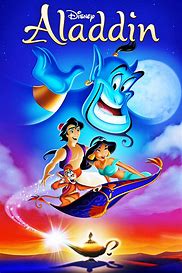
Horizons- The Dark Ride of Dreams

Let’s face it- there is a LOT of negative stuff going on in the world at the moment, and something we could all use right now is the promise of a bright, joyful future full of innovation and hope. When EPCOT Center opened to the public on the 1st October 1982, it let us experience this promise, through a mix of pavilions themed around the countries of the world and various aspects of technology, and, a year after its opening, a pavilion opened that tied together all of the key themes of future world: transport and communication, life and agriculture, and most of all, technology.

It’s time to take a look back at the past, specifically the 80s and 90s, and explore the history of the darkride that is now considered one of the world’s most legendary: Horizons!

Concept and Construction

Walt Disney envisioned EPCOT as a city of the future, integrating new ways of living, communicating and getting around- known as the Experimental Prototype Community of Tomorrow, with the name abbreviated to the one we all know today. Eventually the concept evolved into a theme park centring around the themes of innovation of technology, which would celebrate technology now and in the future using two main areas: Future World and World Showcase.

The pavilions for Future World would include a Life and Health pavilion (which would eventually become Wonders of Life, check out the link at the bottom of this article to learn more about this one!), an agriculture pavilion, and a pavilion showcasing the powers of imagination, as well as several others including the concept for a movie pavilion which would eventually grow into a whole theme park. (Hollywood Studios!)

Horizons was planned to be a sequel to the Magic Kingdom’s Carousel of Progress, which was first unveiled at the 1964 New York World’s Fair, and went through several names during during it’s design. The ride would originally be named Century III, symbolising how, at the time, the US had existed as an independent country for just over three centuries. It was decided that the name would be changed to be appeal more to international guests, so Futureprobe was chosen, yet this would soon also be changed as the word “probe” as it was seen as having a bit of a medical connotation. After discussion with the pavilion’s sponsor, General Electric, who also sponsored Carousel of Progress in the 1960s, the name ‘Horizons’ was settled on.

While many of Epcot’s Future World pavilions were open ready for the park’s 1982 debut (although some of these weren’t actually completed until a little later), Horizons could not be completed in time, and so Imagineering decided to have the ride ready for the park’s first anniversary the following year. It was an instant success, yet never got much of a queue, due to the OmniMover ride system that resulted in a pretty high through-put. Horizons would continue to operate until the late 90s, when a discovery about the ride’s foundations would mean it was forced to close forever.

A Journey to the 21st Century

The futuristic experience of Horizons began right from the moment when guests entered the queueline, known as the FuturePort, a spaceport with vehicles departing for a journey into the future. On boarding their ride vehicles, riders would enter the first segment of the attraction: Looking Back at Tomorrow, which reminisced about all the different ways in which people once envisioned the future, from an advanced city full of flying machines, to an apartment with a robotic butler, which has since become an icon of Horizons.

Next, guests would be greeted by a huge OmniMax/IMAX screen known as the Omnisphere, which was highly impressive at the time and still would be now, displaying the technologies and science of today, before they would finally visit the future, firstly in the form of an apartment in the city of Nova Cite. The residents of the apartment would be a grandfather playing a new type of musical instrument, and a grandmother conversing via videocall with her daughter, an agricultural engineer in the desert region of Mesa Verde.

Riders would visit the farm where their daughter was working, getting an almost birds-eye view of the new innovative methods of farming using aquaponics (which is now used in the Living Laboratory in Living With the Land!). Soon you could visit the engineer’s apartment home, where her son and husband were baking a birthday cake, and her daughter was on a videocall with her boyfriend, a marine biologist studying in the floating city. On arriving there, we meet her boyfriend, who is fixing some kind of submarine vehicle, before seeing an underwater classroom and restaurant.

We then travel from the sea to the sky in a matter of seconds, and meet a family who has just arrived at the Brava Century Spaceship. The final main scene shows a family celebrating their a birthday via videocall- something many of us have done last year and this year!

The next segment of the experience was truly revolutionary. Riders were given the chance to choose the final part of their ride experience, with an innovative “Choose Your Own Tomorrow” function that offered 31 seconds of adventure through a future within either the desert, space or underwater. This added a certain level of uniqueness to the attraction, and meant that you had to ride at least three times in order to experience everything that Horizons had to offer.

The First Closure (and Sudden Reopening!)

Back in the early days of EPCOT, many of the park’s pavilions, particularly in Future World, relied on sponsorship from external companies for much of their maintenance. Horizons was no exception, with a ten year sponsorship deal with the aforementioned General Electric, and when the ten years ended in late 1993, Horizons closed until further notice, much to the dismay of fans.

The much-loved darkride wouldn’t stay closed for long however, as by the end of 1995 it would suddenly reopen, completely unchanged from its original form, likely in order to bring up ride count while its neighbouring pavilions, were under renovation, with World of Motion being reimagined to become Test Track, and Universe of Energy undergoing a major refurbishment. The latter attraction would continue as to operate as Ellen’s Energy Adventure until 2017, when it would suffer a breakdown during its final ride (slightly unfortunate, but at least it allowed guests to get up close and personal with the ride’s sets during the evacuation!), and its former site is now being reimagined into Guardian’s of the Galaxy: Cosmic Rewind.

The Second- and Final- Closure

Horizons would only remain operational for four more years, and by 1999, with Test Track and Universe of Energy having opened a few years prior, and Horizons appearing to be suffering from a lack of maintenance, the ride would close permanently in January of that year, with rumours of a space pavilion (which was planned to be part of Future World from the very beginning!) yet no announcement so far of what would replace what was Epcot’s most loved attraction. In 1996, plans for a space pavilion were seen in a document proposing the concept, so this was the most likely fate for the site- and this turned out to be correct, with Mission: Space being announced soon after Horizons’ closure.

Epcot’s space pavilion was originally planned to be housed inside Horizons’ show building, but a discovery by the Disney company shortly after the closure would make this impossible. Epcot had been built on marshy ground, which could no longer support the massive show building, which had been putting a lot of stress on the land due to the large sets and heavy OmniMover ride system, and the structure was becoming unsound. Subsequently, Disney made the decision to have the new attraction constructed inside a smaller building that would put far less stress on the ground.

Mission: SPACE made its debut on 15th August 2003, as the park’s second simulator attraction after Body Wars opened over at the Wonders of Life pavilion in 1989. The ride featured two missions: Orange and Green, with Orange offering an extremely intense expedition to Mars, and Green allowing guests to take a more-family friendly journey to the moon.

Today, although not a part of EPCOT Center’s first nine pavilions, and opening over twenty years after the park, Mission: SPACE is one of the few attractions that still truly represent the original vision for Epcot: education and entertainment in an immersive, futuristic environment, even if it is a little too intense for some people! (I may be a fan of intense ride experiences, but even the Green Mission is definitely not my favourite part at Epcot!)

References to a Missed Ride

We may not be able to experience Horizons anymore, but what is arguably the most missed Epcot attraction hasn’t certainly disappeared from the park. Imagineers have added little references to the ride throughout the entrance area, queueline and shop for eagle-eyed fans of Horizons to spot. As you approach the pavilion you can see a planter, which at first doesn’t seem to hold a whole lot of significance, but this is actually the same planter that held a marquee in front of the former attraction, and while you travel through the queueline, the rotating gravity wheel contains the simplistic Horizons logo at its centre. This same logo can be spotted at the front of the till in the gift shop.

Tying into the lore of the lost attraction, the upcoming Space 220 restaurant (which is looking amazing!) has been announced to be set within the Centuari Space Station! It’s pretty common for Disney to sprinkle little references to defunct attractions throughout their replacements, and what better way to remember such a beloved attraction!

Did you ever get the chance to experience Horizons? Do you prefer Horizons or Mission: SPACE? Let me know in the comments below!

If you enjoyed this article, be sure to check out my other posts from around the world, and subscribe to have all the latest CoasterDreamers content delivered straight to your inbox!

Frozen vs. Maelstrom: the battle of the Norway Pavilion

Norway is a country of beauty, wonder and of course adventure, and this was represented incredibly well by the Norway Pavilion in Epcot’s World Showcase. The pavilion opened in June 1988, and for over 25 years remained largely the same, with a single darkride that brought the spirit of Norway to Florida, among other services…

Camelot Theme Park: A Medieval Knightmare

It’s 1983. Twenty-one years after the Martin Mere lake of Lancashire was drained, a brand new theme park was opening on the land. At first Camelot Theme Park, named after the story of Camelot and The Knights of the Round Table, was a huge success among the families who visited, however, as larger and more…

You are all clear… and outta here! Thanks for reading!

-Lily

Design a site like this with WordPress.com
Get started