Of all the themed lands that have ever entertained guests at Disney parks, Tomorrowland has always been one of the most problematic. This hopeful world has gone through a range of updates since it first debuted with Disneyland in 1955, mainly to make sure it always remains as a promise of what’s to come, rather than a reminder of yesterday.
Combine this with budget problems during Disneyland’s constructions, and Tomorrowland has become a place where new technology can bloom, but also where imperfect ride concepts have the potential to flop… hard. Sit back, hold on and prepare for short-lived thrills as we explore the history of Rocket Rods!
The First Tomorrow
Disneyland is the most magical place on earth, but the kind of magic that builds a theme park requires a lot of hard work and ambition. The park took an impressive one year to build but it soon became apparent that the budget just wouldn’t stretch far enough to get everything finished- and while every land had plans pushed back, Tomorrowland was the worst affected.
Not wanting to postpone the opening day, or have Tomorrowland open later on, Walt Disney reluctantly decided to seek sponsorship for some of the attractions. Soon, companies selling everything from cars to paint had a place in the land, opening pavilions that both promoted their brands and offered a look into the future they hoped for. Most of these made sense being in a theme park, such as a House of the Future. Not all of them seemed particularly magical however- anyone fancy a walk through the Aluminium Hall of Fame?
Not every Disney attraction has been kid-friendly! Click below to learn about some of the strangest attractions ever to have a place at a Disney park!
A Different Kind of Magic- the strangest, creepiest and outright terrifying attractions to operate at Disney Parks- Part One
The main target market for Disney’s many theme parks around the world has always been families- this was made clear by Walt Disney even before Disneyland opened in 1955, when he said he wanted to create a fun little park for kids and kids-at-heart to enjoy together. But that’s not to say Disney rides and…
Keep reading
Always on the Move
Tomorrowland may have had a rocky beginning, but it wasn’t long before the world of the future found its feet. The opening of an updated version of the land in 1967 introduced a range of new attractions, many of which are still well-remembered today. Among the most popular was the PeopleMover, a prototype of tomorrow’s public transport, which offered riders incredible views of the land, via tire-propelled trains that were constantly moving.
Like the rest of Tomorrowland, the concept for the PeopleMover was built on new technology, but that’s not to say the idea had not been thought of before. When Walt Disney first came up with the idea for EPCOT, then planned to be a city of innovation rather than a theme park, the main form of transport was going to be a monorail that travelled through and around the city centre. This dream came to life with the opening of the Disneyland Monorail in 1959, however that still wasn’t the end of it. The technology appeared again on the Ford Magic Skyway at the 1964 World’s Fair, before finally being used inside a Disney park. Tire company Goodyear came forward to sponsor the attraction, and the PeopleMover was an instant success.
New Tomorrowland was a massive project, but it was far from being the only thing Disney were working on in the 1960s. Between developing films and attractions, Walt Disney and the Imagineers had developed plans for the ‘Florida Project’, originally intended to be a slightly different, but still very similar extension of Disneyland. The project didn’t actually break ground until after Walt Disney’s death, but with the oversight of his brother Roy, Florida’s newest theme park quickly grew from a second Disneyland into a full-blown resort, home to two golf courses, two hotels and the Magic Kingdom theme park.
It was famously said that Disneyland would never be complete, and the same applied to its East Coast reimagining. Walt Disney World first welcomed guests on the 1st of September 1971, with a range of new attractions and hotels opening in the following years. Around five months after Space Mountain, the PeopleMover made its Florida debut in 1975. This version would go through a number of sponsorships and voiceovers, and although not as popular as before, is still transporting guests through Tomorrowland to this day. However, the original did not have the same fate.
Looking Ahead
Out of all the CEOs the Walt Disney Company has had, Michael Eisner is arguably one of the most memorable. Making changes that some Disney fans have quite strong opinions on, Eisner brought both imagination and cost-cutting to the theme parks, and just one of the decisions he implemented is that the space and energy taken by older attractions may be better dedicated elsewhere. Sadly, Disneyland’s version of the PeopleMover was one of the rides affected by this, giving its last rides in August 1995.
The 90s were certainly an interesting time for the Walt Disney Company. Click below for a quick tour of the era referred to as the ‘Disney Decade’!
A Short(ish!) History of the Disney Decade
September 1984 marked the beginning of Michael Eisner’s reign as Disney CEO, and he had huge plans for the company. At the time Disney were struggling to stay afloat, with consistently delayed projects piling up; the innovative magic we all know and love today wasn’t exactly the top priority. In spite of Disney’s many struggles…
Keep reading
1967 was the year that Tomorrowland received its first major update, but it wasn’t until 1998 that a newer New Tomorrowland would open. In the place of the PeopleMover stood a new attraction, using the same foundations but different technology, and for a different target audience. Rocket Rods was more modern and exhilarating… but also a lot more problematic.
The PeopleMover and had been built for slow, gentle journeys, but Rocket Rods was designed for thrills. Riders would make their way through the building that was housed Circle-Vision 360°, now bringing to life the history of transportation. If this sounds familiar, that’s because it was the theme of the former World of Motion attraction at Epcot!
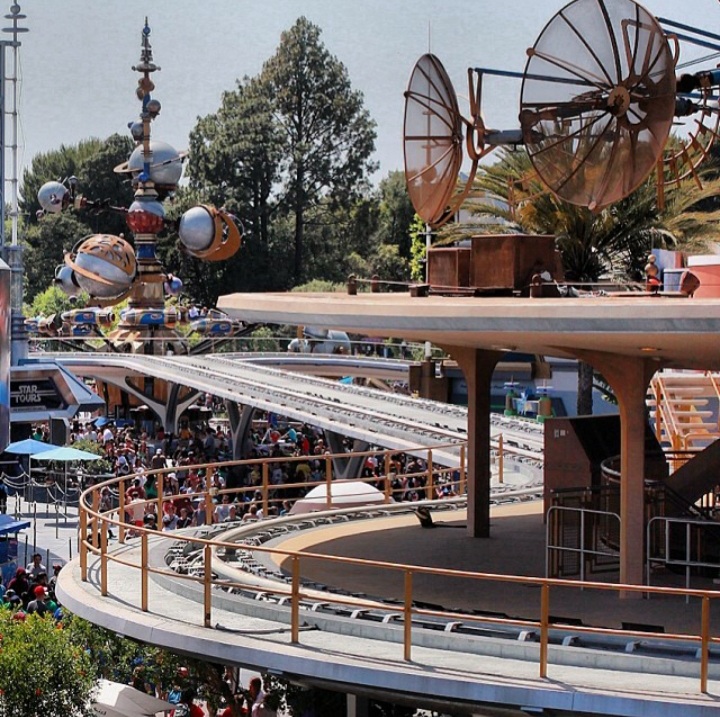
Before you knew it, it was time to board. Guests would wait for their ‘rods’ to arrive at the station, and once seated entered a room sure to get the adrenaline flowing. Lights would provide a countdown from red to yellow to green… then it was time to launch. Similar to the PeopleMover, your rod would take you on a journey through the Star Tours queueline, into the darkness of Space Mountain, as well as on a grand tour of Tomorrowland, only this version added some new thrilling elements too. At one point in the ride, a mirror created the illusion that you were heading straight for another rod, only to whizz past unscathed, while at another, you would race alongside the monorail.
Rocket Rods added an extra level of thrill to Tomorrowland, however it can be argued that the land didn’t really need it, considering many of the most popular attractions there were already thrill rides. The fact that it had replaced a beloved, classic ride also meant it may not have been as well-received as Imagineering had hoped, but the failure of Rocket Rods mainly came down to something that had caused and still causes many attractions to meet their demise: technical problems.
Downtime and Deceleration
Part of the appeal of Rocket Rods was that it was fast, however riders soon learned that this wasn’t quite the case. A pretty low budget had meant that the sides of the track couldn’t be properly banked, meaning that every time a rod approached a turn, it would have to slow down again just to make it around. The old PeopleMover structure was weakened by the stress coming from these awkward turns and the computer system couldn’t cope either- frequent changes in speed caused it to often shut down. Near-constant downtime due to this meant guests were spending hours waiting in line, and seeing as no one likes queueing this didn’t do much for the ride’s diminishing reputation. A short refurbishment in 1998 was supposed to fix at least some of the technical hitches, but was pretty much futile.
By 2000, everyone had just about enough of Rocket Rods’ plague of problems, and in September the attraction closed for a year long refurbishment. A year came and went… but the racing ride never reopened. In April 2001, around the same time Rocket Rods was originally meant to restart operation, it was announced that Disneyland’s almost-thrill-ride would close permanently. The rods were eventually scrapped, and the queueline formed part of Buzz Lightyear’s Astro Blasters. However, the old foundations and tracks were never removed.
Looking To the Future
All that remains today of Disneyland’s PeopleMover and Rocket Rods are a few foundations and track layout, but will the classic former attraction ever return? I definitely hope so! The only other version of the ride still exists at Magic Kingdom, now named the Tomorrowland Transit Authority PeopleMover, and isn’t showing any signs of closure, despite not gathering much of a queue. Its certainly not the most popular ride in Tomorrowland, but offers some salvation from walking around the park, which I think we all need sometimes when visiting theme parks.
There’s always demand for the type of ride you go on to relax, and I believe something like the Disneyland PeopleMover has a lot of potential for rethemes. Big Hero 6 would be a possible IP, with indoor sections themed to San Fransokyo, especially as the film seems to be gaining more of a presence across some of the Disney parks. A ride themed to Tomorrowland: A World Beyond may also work well, as this film literally features its own PeopleMover/Monorail type thing, and this could be an option if Disney didn’t want to do a full reimagining. (And its a great film too- I recommend it!)
Did you ever get the chance to ride Rocket Rods? What do you think Disney should do with the remaining structure? Let me know in the comments!
If you enjoyed this article, check out some of my other posts from theme parks and attractions around the world, and find us on Facebook and Instagram for exclusive content!

No Way Out: The History of Thorpe Park’s X and the Walking Dead
Throughout its forty-three year history, Thorpe Park has been home to some pretty amazing rides. From petting farms to high-speed thrill rides, there has always been something for everyone, and some attractions leave more of a legacy than others. Among now defunct greats is X:/ No Way Out, which took riders on an adventure through…
Reaching for the Skies- the Evolution of London’s Airports
CW: Mentions of War and the Pandemic For years, aviation has been a massive part of the travel industry, whether you’re travelling to a far-flung location, or your destination is just a little too far to drive or go by ferry. But like any flight, the story of London’s five airports hasn’t been without turbulence.…
From Europe and Beyond- the history of Center Parcs | DreamVenture
If you’ve booked a European holiday in the past fifty-four years, chances are you’ve at least come across Center Parcs. First founded in 1968, this popular holiday park chain provides holidays aimed at those looking for an adventure, but also to escape the stresses of day-to-day life. But with an impressive twenty-eight resorts, two brand…
 Coaster Dreamers